Showing posts with label Peter Sarsgaard. Show all posts

Monday, 16 January 2017

Jackie

The assassination of John F. Kennedy is one of the most well-known events of modern history. When most people consider the aftermath of his untimely death, attention is usually drawn to Lee Harvey Oswald and his subsequent murder, and light is rarely shone on the intimate details of his family and widow. Jackie delves deeply into a previously shallow part of this time in history, and stands as a powerful and sombre biopic about a grieving widow struggling in the public eye.

Following her husband's assassination, Jackie Kennedy (Natalie Portman) is left to try and hold together her life in a time of despair and confusion. Jackie explores the former First Lady's immense loss and different stages and experiences of grief, as it darts between her time in office before the assassination, the event itself, the immediate aftermath and an intimate interview a week onwards. Between arranging her late husband's funeral and explaining to her children why daddy isn't coming home, all while being berated with advice and consolations from advisors, this film follows the titular Jackie in a truly sad and tumultuous time.

In a film named after a character, there is no doubt going to be a massive focus on the actor or actress playing them. In the case of Jackie, Natalie Portman is tasked with exploring the complicated emotions associated with grief and loss. From struggling to remain composed and poised in the public eye, to frantically breaking down and sobbing in private, Natalie Portman greatly achieves this much needed range and carries the character throughout the entire film. Rarely can the facial expressions, dialogue and reactions of a single character render an entire theatre gobsmacked, but Natalie Portman absolutely does so in her performance as the former First Lady. This isn't even considering her imitation of Jackie Kennedy's signature accent (which she totally pulls off, by the way).


The entire film is wholesomely engaging and awe-inspiring. With a fragmented story darting back and forth between various events both before and after JFK's assassination, the audience is kept on their toes and engaged with what is unfolding. While the movie and Jackie's intimate interview (which serves as a base-line for the film's narrative) are based on a real interview conducted a week after her husband's death, we cannot be sure that all the intimate details of the story are true. This being said, even if Jackie's actions in the movie are stretched slightly beyond the truth, no doubt the grief and sadness emanated throughout them are accurate, and seeing these emotions displayed so beautifully on the big screen really hits home. Accompanied with a sombre and simple orchestral soundtrack, the mellow tone of the movie is really driven into the audience to great effect.

This movie carries great parallels between beauty and pain, from constantly contrasting Jackie's life before and after the assassination, to her comparison of her husband's time in office to a real-life Camelot. Through this same vein, Jackie is a great example of a movie which finds beauty in sadness, and is wholeheartedly engaging the whole way through. If you are prone to cry, bring some tissues, and prepare yourself for a performance that will no doubt snag a Best Actress Oscar nomination for Natalie Portman.


Saturday, 1 October 2016

The Magnificent Seven

Seven Samurai is a classic film that has been reimagined in many different ways, as a western (The Magnificent Seven) and a space opera (Battle Beyond the Stars). Many movies, specifically westerns take elements from this movie, but never has it been so blatantly remade. Rather than follow the path of it's namesake, this new Magnificent Seven is a straight remake of Seven Samurai, even going so far to use a watered down version of the classic's screenplay.

The town of Rose Creek is being harassed by Bartholomew Bogue (Peter Sarsgaard), a businessman who intends on buying the whole town in order to mine it of all the gold it has. Desperate to save her town, Emma Cullen (Haley Bennett) leaves to look for protection. She comes across bounty hunter Sam Chisolm (Denzel Washington) who agrees to help but admits that they need more people. They gather a team that includes Faraday (Chris Pratt), a drunken Irishman hustler without the accent, Goodnight Robicheaux (Ethan Hawke), a former Confederate sharpshooter, his companion Billy Rocks (Byung-hun Lee), a Chinese immigrant who is a knife expert, Jack Horne (Vincent D'Onofrio), a mountain man, Vasquez (Manuel García-Rulfo), a Mexican outlaw, and Red Harvest (Martin Sensmeier), a young Comanche warrior who has been exiled from his tribe. Together this band returns to the town to square off against the forces assembled by Bogue.

Because this movie leans so heavily on Seven Samurai it's really hard to reconcile that this movie is trying to be it's own thing. I know it sounds wanky to say that, but if you've seen that movie, you'll understand the parallels. Things like the introduction of characters (especially Billy Rocks' introduction which is lifted straight from Seven Samurai) or the training of the villagers are just so close to the original film. This seemed bizarre to me because the only connection it has to the original Magnificent Seven is the name and setting. Even though it's trying to be Seven Samurai, it manages to miss the mark by trying to be different. Straight away the movie starts with villainy to make sure that they know Bogue is the bad guy, but there's no gentle build up to it. And instead of having a town meeting to decide go for help, the character of Emma Cullen takes it upon herself to go look for help. Peter Sarsgaard's Bogue is one moustache twirl away from being the kind to tie a woman to the railroad and really does look like a discount Paul Giamatti. When it comes to the big battle at the end of the film, the stakes are dramatically lowered because the whole town takes part in it. This takes away from the whole underdog story. The movie also has a few historical problems. First off, the old west was nowhere near as clean as this. I don't mean that everything is super shiny and new, but it is far from the grittiness that we've come to expect from modern westerns like Deadwood, True Grit and Django Unchained. These days you have no excuse to muddy up you actors. Another minor failing I thought the film had was the lack of discussion around Chisolm obviously being a former slave. This movie takes place in the South in 1879. The Civil War would have been too recent an event to ignore and the film even says that Chisolm had been lynched at some point.


The Magnificent Seven isn't just a steaming mess though. It does have some good elements. The action is exactly the kind of thing you want to go see with this kind of movie, lots of old timey bullets, explosions and tomahawks. The chemistry between Chris Pratt and Manuel García-Rulfo is off the charts and just a joy to watch. Fun fact: when you can't put swear words in a movie, have the Mexican guy call everyone cabron (fucker in Spanish). Vincent D'Onofrio's choice of a squeaky whisper is hilarious and almost made me laugh every time he said something. Although I found it hard to believe that Ethan Hawke's former Confederate soldier would be friendly with Chisolm, the addition of his PTSD from the Civil War was a nice touch. The ending was a nice touch because it was more in keeping with it's source material than a conventional Hollywood ending.

This movie has quite a few ups and downs so it's quite hard to say whether or not I liked it. Within the first five minutes I thought I had written it off as a horrible movie, but it wasn't horrible. Instead it just hung in a strange limbo between good and bad. While the bad parts don't detract from the movie itself, they do serve as a distraction.

Sunday, 11 October 2015

Black Mass


South Boston, or 'Southie', has been the subject of many a crime film over the past decade and a half. Movies like The Town, Southie, The Departed and even Good Will Hunting have striven to accurately portray one of the roughest neighbourhoods in the United States. But one notorious figure has yet to be portrayed on film; that of James 'Whitey' Bulger (Okay so not necessarily true, Martin Scorsese's The Departed was based on his crimes).

Bulger (Johnny Depp) is the leader of the Winter Hill Gang in South Boston during the mid-1970s. He is well known in the community as both a gangster and a pillar of the community. His brother Billy (Benedict Cumberbatch), a state senator, is contacted by their childhood friend John Connelly (Joel Edgerton), who is now a FBI agent who has been tasked with reducing Mafia activity in Boston. He sees Bulger as the key to bringing down this stranglehold they have. So Bulger becomes an informant, all the while continuing his own criminal activity.

This success of this film hinges entirely on whether or not you find Depp's performance as Bulger convincing. Unfortunately for me, I wasn't convinced. Yes, he is unnerving, but I wasn't scared by him, which is the whole point. I think that they were relying on his makeup and new look to add to the performance but it did nothing for me. Outside of this, there isn't too much going on. At a stretch you could say that the intrigue surrounding Bulger's manipulation of the FBI is interesting, but not enough to be exciting.


In fact the film seems like it purposefully goes out of its way to be obtuse. There is a whole subplot involving who owns World Jai-Alai, a sport the movie even admits no one knows what it is (unless you're like me and you do know what it is (I lie, I have no idea what they're doing)). I also feel like this film is needlessly violent. I know Whitey Bulger was an incredibly psychotic film, but you don't need to show every single murder he committed. Sometimes implied violence is just as effective. I also feel like the movie dropped the ball with the ending. It is a well known fact that Bulger was apprehended in 2011, yet the film ends in 1995 with an epilogue about his capture.

Because Depp's performance is so dominant here that the others don't really get a look in. Joel Edgerton's is the only one that is on par with Depp, but it isn't very good. Everyone else is really in the background which is disappointing considering the cast. Benedict Cumberbatch, Kevin Bacon, Adam Scott and Rory Cochrane are all fantastic actors, and while they are in a lot of scenes, they aren't the focus of any of them. Corey Stoll is the only minor performance given any notice, which is good because he carries those scenes. Women are hugely under represented with Dakota Johnson and Julianne Nicholson given barely any screen time.

A hugely disappointing and largely unnecessary biopic. It is not at all engaging, so if you want to see a better film about Whitey Bulger, go rewatch The Departed.


Wednesday, 24 December 2014

War Movie Month: Jarhead (2005)


"You are no longer black or brown or yellow or red. You are now green! You are light green or dark green, do you understand?"

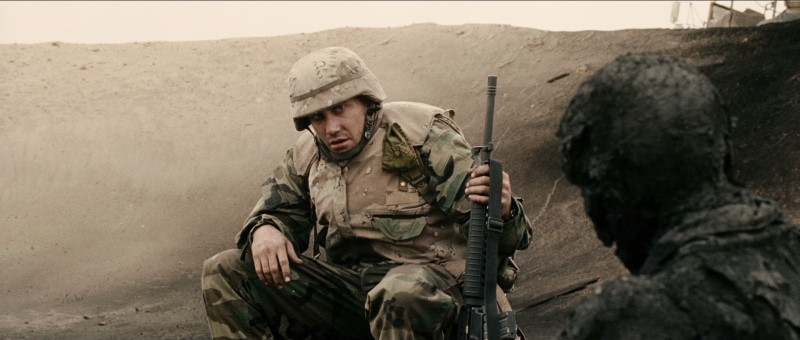
War is boring as hell. It consists of masturbation, dehumanising an unseen enemy, the fear of what those left at home are doing, more masturbation, cleaning your weapons, endless uncertainty and waiting. Jarhead is a film about war with very little combat and it is also about the mind of a soldier. It is a film resplendent in Sam Mendes' quiet artfulness and Roger Deakins' colourful, handheld cinematography, and a script about people who volunteer to become psychologically damaged, with absorbing performances from its leads.

 Jake Gyllenhaal plays Private Anthony Swofford in Sam Mendes' adaptation of the memoirs of the real life Swofford, a veteran of the first Gulf War. Swofford's uncle and father both served in Vietnam, and the vast gulf of difference between his experiences in the Marines and those of his family comes as a great shock. However, Jamie Foxx's Staff Sergeant Sykes soon recruits both Swofford and Troy (Peter Sarsgaard) to become Scout Snipers. Swofford is consumed by the power and prestige of being a sniper, and captivated by the philosophy of the one perfect moment when an enemy in his cross-hairs. After the Gulf War is declared, his unit is sent to defend oil reserves in the Saudi desert, though the lack of combat and formidable desert climate begin to take their toll on the young men.

Jarhead's world of over-whelming ultra-masculinity and reshaping of language into military distinctions contributes into its message about how war changes people, specifically in a war that's unlike many others. It establishes and reinforces that the psychological effects of war on soldiers goes beyond just the brutality of battle and a hostile training regime. With few fronts, and an almost inhospitable setting, the realities of the Gulf War clash tremendously with the expectations of the recruits, and the results of their training. Swofford is obviously influenced by the romantasiced Great Wars, and by the Vietnam War, which had an entirely different enemy, motive, and result. The Vietnam War was also the first televised war, and one where the transformative psychological impact of the conflict because common knowledge, whether that was the training methods, the combat, the weapons used, or the reception when Western soldiers returned home. In contrast, the characters of Jarhead are almost convinced that by waging war against a despot, they can win a romantic war with the modern attitude of a post-Vietnam United States Army.

.But the uniqueness of their situation becomes increasingly blatant, as the advanced state of the American war machine in contrast to the war in Vietnam puts a new burden on the men. As Sarsgaard's Troy says "This war is going to move too fucking fast for us. We can shoot a thousand yards. To go that far in Vietnam, it'd take a week. In World War One, a year. Here, it's gonna take about ten fucking seconds! By the time we have our rifles dialed the war is gonna be a mile down the road." The film makes the point that men are changed not just by the war itself, but by the lifestyle of being a soldier. Language changes, the consistensies of home change, the very land you live on changes, all at a moments notice, They are mentally and physically separate from the people they are defending, and the pain this causes can be justified if they can kill the enemy. Swofford poetically evokes this with the narrated line "The man's hands remember the rifle." And a state of absurdly overbearing  masculinity becomes the social norm in the separate world. Fitness, aggression, semi-mocking homo-eroticism, and all-consuming phallic power are the tenents of this war's culture. These are men who have had all of their desires pinned onto a single act, the act of killing the enemy. Any time they are denied that, their worth is diminished, and with it their psyche.


                                          "Every war is different. Every war is the same."


In Jarhead, music is used less often to fill the sound of scenes but rather to bridge them in concert with the editing. This is a technique that gives a timeless quality in direct contrast to the titled "Time in desert" that appears on-screen.  Roger Deakins most often uses steadicam that, alongside the direct though poetic narration, implants the audience as a silent accomplice to the madness on-screen. Mendes first gained notoriety for his artful tale of suburban lusting American Beauty, but in 2012's Skyfall he also showed that he can take a film that usually exists within a certain style or genre and recontextualise it into a something more directly colourful, artistic and psychologically dense. Though Jarhead is more comparable to David O'Russell's Three Kings in setting and colour grading, the use of lighting, psychology and visual metaphors for mentally broken men creates a bridge between two of Mendes' most mainstream and action-filled films. And William Broyles, Jnr's script helps in no small part. Gyllenhaal ranges from dead-eyed detachment to horrifically honest breakdowns that really show his ability, at a time when he was still a rising star. Sarsgaard and Sykes certainly rise up in great support of Gyllenhaal's lead, but the three are certainly distinct from their enjoyable, though one-note support cast. One's an arsehole, one's a dork, one's a Latino family-man, and none are surprising.

Jarhead is perhaps a forgotten gem in the wake of countless 21st century war dramas that are set in the Middle East, but there is certainly plenty to be found. A good script, some excellent performances and direction, and even effective use of Kanye West's music.

Jasper Roberts Consulting - Widget