Showing posts with label Jake Gyllenhaal. Show all posts

Sunday, 17 July 2016

Demolition

Demolition is the latest film from Jean-Marc Vallée (Dallas Buyers Club, Wild) and stars Jake Gyllenhaal in another of his roles as a dejected man who seems incapable of feeling emotions, a bit like how I felt at the end of this film.

Davis (Jake Gyllenhaal) works in investment banking for his father-in-law Phil (Chris Cooper). Davis and his wife Julia (Heather Lind) are involved in a serious car-crash, and whilst she’s killed, he suffers only minor injuries. Wandering the wings of the hospital afterwards, he has an encounter with a dodgy vending machine and writes a complaint letter to the company that owns it, explaining his troubles for context in a unique form of grief that could only belong to a Gyllenhaal character. However, things take an interesting turn for Davis when he receives a response from customer service representative Karen (Naomi Watts). What follows is one of the most leisurely paced, unprofound, waffling films that we’ve seen so far this year.

Demolition starts off promisingly - a car-crash that will undoubtedly send Davis into a cinematic spiral of insanity - but what follows is...well, tedious. There’s always a couple each year, the films that could be brilliant but end up a conceited mess. Think Words and Pictures. Demolition is one of those. I’m not one to dismiss character-centric dramas, in fact I tend to take a high-horse attitude and think that if you judge a film solely on its supposed ‘lack of plot’, you’re most likely a toddler who hasn’t learnt to think for themselves - bloody plebs, am I right?. But the characters in Demolition are either unrelatable or just plain unlikable, which doesn’t leave much of interest to draw you in.

But that’s just the tip of the iceberg. Throughout there are these little references to 9/11, and whether intentional or not it felt as if it’s was pushing a not-so-subtle message toward how grief has evolved in a post-9/11 America. It also keeps drawing weird linkages between Davis’s dejection and how it could be cured by embracing his inner child. Whilst normally these would be buried deep into our subconscious viewing of the film, in Demolition there’s not a lot more to focus on and so they stand out like a sore thumb. It starts to skate the thin line between intellectual cinema and ‘art for art's sake’.

You also get the impression that detail is important to Davis, and so little close-up montages are scattered throughout. They work but only to a certain point, even though the editing is one of the better takeaways from this. Don’t get me wrong, there are other positives as well. There’s a scene right at the end with a carousel which was about the only time I felt something in the nearly two-hour run time, is that a positive? There’s certainly a handful of funny moments but it’s not laugh-out-loud. A lot of Yves Bélanger’s cinematography is well-constructed and interesting, even if the film isn’t. You can tell that both Gyllenhaal and Watts are invested in crafting good performances but that never really happens because of deeply flawed character writing/direction.

In the early stages of Davis’s downfall, you see him meticulously take things apart, but never put them back together. This film feels a bit like that, a series of scenes that should have some sort of coherence as a whole, but just don’t. It’s not awful, just frustrating, tedious, a waste of talent and of your time.

Saturday, 19 September 2015

Everest

I love a good disaster movie, and I absolutely loath a bad one so Baltasar Kormákur's Everest had a lot riding on it for me. Based on the events surrounding the 1996 Mount Everest disaster, the film's stellar cast, chilling story and international production promises a unique and visceral experience. As with all biographical films, if you don't know the story, don't read up on it before going in. Needless to say though, people are gonna die.

Rob Hall (Jason Clarke) is a professional mountaineer whose business, Adventure Consultants aims to get people to the summit of Mount Everest, the tallest mountain in the world, and back down again as safely as possible. It's the start of the 1996 season and Hall is leading an expedition of eight clients, including Texan doctor Beck Weathers (Josh Brolin), journalist Jon Krakauer (Michael Kelly) who's documenting the trip, and Doug Hansen (John Hawkes) a mailman who is on his second attempt to climb the mountain. Hall says goodbye to his pregnant wife Jan (Keira Knightley) and the expedition gets underway.

At base camp they meet up with Helen Wilton (Emily Watson) who is managing the Adventure Consultants' tent, and Caroline Mackenzie (Alicia Vikander), the expeditions doctor. Scott Fischer (Jake Gyllenhaal) is running another expedition and is technically a business rival of Hall's. However, since they both aim to summit on May 10, the two decide to team up the expeditions and work together to reach the summit. However, a string of delays and encroaching bad weather ensure that the expedition ends in disaster.

Everest's rocky beginning hints at a relationship-focused but cliche-driven plot. Conversely, its subtle ending is the perfect close to a relentless, spine-chilling, brilliant film. Full disclosure: I saw this one in 3D, which I'm normally not a big proponent for. Its often either too distracting or not effective. However, here it captures the immense scale of the deadly mountain, the depth of the black crevasses, the ant-sized humans tackling an impossible task. The mountain is the star of this movie, it "has the final word", it's the ultimate antagonist. Full credit to DoP Salvatore Totino (Frost/Nixon) and the effects teams on this film for capturing the sheer beauty of such a deadly place. Each sequence is gripping and utterly realistic. At no point could I not suspend my disbelief. The true success of this film is its focus on spectacle, its ability to create an atmosphere and put the audience right in the action. 

Everest divides its time between the seemingly successful training/ascent and the tragic descent. All the while developing its ensemble of characters as we watch on hopelessly. The minutiae of the ascent, little things that ultimately see the characters set up to fail, are presented in an almost documentary-like style. No blame is laid, no message pressed about the fragility of human ambition. Kormákur simply presents the events as they unfolded and we're taken along for one hell of a ride. It's amazing how littered with A-list actors this film is, many of whom get very little screen time. Strong character development is sadly limited to a couple of the key roles, and at times - especially when they're into the 'death zone' and totally rugged up - it's difficult to work out who's who and what their individual slice of the story arc is. 

Jake Gyllenhaal gives a small but lively performance, and Brolin is well-rounded as Beck. Hawkes's Doug Hansen is one of the more interesting and fleshed-out characters, an amateur climber with a quiet persona and a lot of heart. The absolute standout though has to be Jason Clarke in the lead. Clarke has always had a lot of misses for me, especially in his Hollywood roles, but returning to his native tongue (well, New Zealand is close enough to Australia) has certainly paid off, because this is his best performance to date. He portrays Hall as a gentle, kind-hearted man who puts the safety and concern of his clients above all else. He's so good that all you really want towards the end is for him to survive. 

The women however, are left with generally unfulfilling roles. Emily Watson is fantastic as usual, and you really feel for her as she tries to manage the disaster from the base camp, however most of her screen-time she's left trying to communicate to people through a radio. Alicia Vikander does what she can as the expedition's doctor but she too is unable to do much from the base camp. Robin Wright has an unbelievably small role as Beck's wife, similar to Keira Knightley, who can't pull off the greatest of New Zealand accents but is responsible for one half of the film's most heartbreaking conversation toward the end, so she should still get some credit. 

Whilst there are some great portrayals from a stellar cast in Everest, and I think a lot of reviewers are downplaying the character development, this is still a film that's driven by spectacle. Its slightly emotionally-detracted style avoids cliche whilst still doing justice to a thrilling story that captures the essence of the human condition and transports you to the frosty Himalayas. Everest leaves you with both the desire to endeavor to climb it and at the same time, the tragic gut-necessity to stay as far away as possible.

Wednesday, 26 August 2015

Southpaw

After the first photos emerged from Southpaw, all everybody could talk about was Gyllenhaal's physical transformation for the role. But since the metamorphosis of actors seems to be the current zeitgeist of Hollywood, I was more interested in what director Antoine Fuqua could do with his dark cinematic style and a sports drama. The answer is: everything that's been done before, with Eminem slapped over the top.

Billy Hope (Jake Gyllenhaal) is an undefeated light heavyweight boxer with a wife Maureen (Rachel McAdams) and daughter Leila (Oona Laurence). Billy lives the high life, with his large mansion and blinged-up posse, but after sustaining an eye-injury during a match, Maureen convinces him that it's time to retire. After another boxer, Miguel Escobar (Miguel Gomez) taunts him, leading to a very public brawl, Maureen is accidentally hurt and dies at the scene. Heartbroken and depressed, Billy also loses his daughter to social services. The only way he can get his daughter back is to get his life back on track, which he starts doing by getting a job at a gym owned by ex-boxer Titus "Tick" Wills (Forest Whitaker). After Tick starts to train Billy, he strives once more to seek the redemption he needs.

This is basically an hour of watching Billy Hope's life fall apart, then an hour of him picking up the pieces, in the most unoriginal of ways. I have no doubt that Gyllenhaal gave this role his all, but his character is constantly reduced to polarising extremes of emotions - either depression or extreme anger - but never anything in-between. The blame very much lies with the plot, which, cliche after cliche, tells the same story of redemption that we've seen in boxing films more times than anybody would like to admit. The first act of Southpaw establishes the obnoxious characters, entrenched in a shallow, tedious world. The early development is so shockingly bad that I honestly couldn't care less about Hope's wife dying. From the banal script-writing to the emotion-milking dialogue, the film opens a wreck.

It's not until the second act, when Whitaker's character comes into the mix that Southpaw manages to conjure up some dignity. Whitaker similarly pours everything into Tick, and at times the potential of the character shines through, but he's eventually reduced to the typical enigmatic black motivational trainer movie trope. If it wasn't him, it was Morgan Freeman in Million Dollar Baby before him and so on. As for the other characters, McAdams's portrayal of a sidelined boxer's wife is as dreary as it is two-dimensional, and 50 Cent's character is just an outright arsehole. The biggest insult is the suggestion that we could empathise with almost any of these characters.

Boxing films are well known for their cinematic exuberance, and at times Mauro Fiore manages to capture the raw emotions of the moment, but Southpaw visually lacks the ingenuity that others like it have been brave enough to attempt, and ultimately the film is degraded to the archetypal training montages - complete with Eminem soundtrack - that we could all see coming from a mile off.  In the end, Fiore can't manage to stretch the style of Southpaw beyond what we've seen before. 

Of all the great boxing films - Million Dollar Baby, Raging Bull etc. - the triumphant ones create an atmosphere and tell an original story. Whilst the two leads manage to conjure up surprisingly decent performances given the material, Southpaw is ultimately the antithesis of original, and risks fading into mediocrity.

Wednesday, 24 December 2014

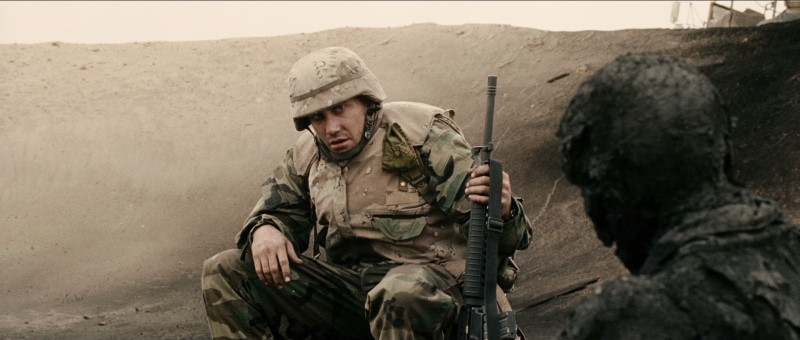
War Movie Month: Jarhead (2005)


"You are no longer black or brown or yellow or red. You are now green! You are light green or dark green, do you understand?"

War is boring as hell. It consists of masturbation, dehumanising an unseen enemy, the fear of what those left at home are doing, more masturbation, cleaning your weapons, endless uncertainty and waiting. Jarhead is a film about war with very little combat and it is also about the mind of a soldier. It is a film resplendent in Sam Mendes' quiet artfulness and Roger Deakins' colourful, handheld cinematography, and a script about people who volunteer to become psychologically damaged, with absorbing performances from its leads.

 Jake Gyllenhaal plays Private Anthony Swofford in Sam Mendes' adaptation of the memoirs of the real life Swofford, a veteran of the first Gulf War. Swofford's uncle and father both served in Vietnam, and the vast gulf of difference between his experiences in the Marines and those of his family comes as a great shock. However, Jamie Foxx's Staff Sergeant Sykes soon recruits both Swofford and Troy (Peter Sarsgaard) to become Scout Snipers. Swofford is consumed by the power and prestige of being a sniper, and captivated by the philosophy of the one perfect moment when an enemy in his cross-hairs. After the Gulf War is declared, his unit is sent to defend oil reserves in the Saudi desert, though the lack of combat and formidable desert climate begin to take their toll on the young men.

Jarhead's world of over-whelming ultra-masculinity and reshaping of language into military distinctions contributes into its message about how war changes people, specifically in a war that's unlike many others. It establishes and reinforces that the psychological effects of war on soldiers goes beyond just the brutality of battle and a hostile training regime. With few fronts, and an almost inhospitable setting, the realities of the Gulf War clash tremendously with the expectations of the recruits, and the results of their training. Swofford is obviously influenced by the romantasiced Great Wars, and by the Vietnam War, which had an entirely different enemy, motive, and result. The Vietnam War was also the first televised war, and one where the transformative psychological impact of the conflict because common knowledge, whether that was the training methods, the combat, the weapons used, or the reception when Western soldiers returned home. In contrast, the characters of Jarhead are almost convinced that by waging war against a despot, they can win a romantic war with the modern attitude of a post-Vietnam United States Army.

.But the uniqueness of their situation becomes increasingly blatant, as the advanced state of the American war machine in contrast to the war in Vietnam puts a new burden on the men. As Sarsgaard's Troy says "This war is going to move too fucking fast for us. We can shoot a thousand yards. To go that far in Vietnam, it'd take a week. In World War One, a year. Here, it's gonna take about ten fucking seconds! By the time we have our rifles dialed the war is gonna be a mile down the road." The film makes the point that men are changed not just by the war itself, but by the lifestyle of being a soldier. Language changes, the consistensies of home change, the very land you live on changes, all at a moments notice, They are mentally and physically separate from the people they are defending, and the pain this causes can be justified if they can kill the enemy. Swofford poetically evokes this with the narrated line "The man's hands remember the rifle." And a state of absurdly overbearing  masculinity becomes the social norm in the separate world. Fitness, aggression, semi-mocking homo-eroticism, and all-consuming phallic power are the tenents of this war's culture. These are men who have had all of their desires pinned onto a single act, the act of killing the enemy. Any time they are denied that, their worth is diminished, and with it their psyche.


                                          "Every war is different. Every war is the same."


In Jarhead, music is used less often to fill the sound of scenes but rather to bridge them in concert with the editing. This is a technique that gives a timeless quality in direct contrast to the titled "Time in desert" that appears on-screen.  Roger Deakins most often uses steadicam that, alongside the direct though poetic narration, implants the audience as a silent accomplice to the madness on-screen. Mendes first gained notoriety for his artful tale of suburban lusting American Beauty, but in 2012's Skyfall he also showed that he can take a film that usually exists within a certain style or genre and recontextualise it into a something more directly colourful, artistic and psychologically dense. Though Jarhead is more comparable to David O'Russell's Three Kings in setting and colour grading, the use of lighting, psychology and visual metaphors for mentally broken men creates a bridge between two of Mendes' most mainstream and action-filled films. And William Broyles, Jnr's script helps in no small part. Gyllenhaal ranges from dead-eyed detachment to horrifically honest breakdowns that really show his ability, at a time when he was still a rising star. Sarsgaard and Sykes certainly rise up in great support of Gyllenhaal's lead, but the three are certainly distinct from their enjoyable, though one-note support cast. One's an arsehole, one's a dork, one's a Latino family-man, and none are surprising.

Jarhead is perhaps a forgotten gem in the wake of countless 21st century war dramas that are set in the Middle East, but there is certainly plenty to be found. A good script, some excellent performances and direction, and even effective use of Kanye West's music.

Friday, 28 November 2014

Nightcrawler

"You filmed him die."
"It's my job. I like to say that if you see me you're having the worse day of your life."


Jake Gyllenhaal is gaunt, verging on skeletal, wide-eyed, spewing entrepreneurial rhetoric, and is yet wholly terrifying as Louis Bloom, a man desperate enough to do anything to be successful in the orange and yellow-hued streets of night-time Los Angeles. Nightcrawler is the directorial debut of screen-writer Dan Gilroy (The Fall, Real Steel and Two For the Money) that also stars Riz Ahmed, Bill Paxton and Gilroy's real-life wife, Rene Russo who all become a part of Lou's small corner of the underworld of night-time news journalism.

The film opens on a series of establishing shots of Los Angeles at night, awash with colour, where life and noise is ever-present off-screen, and the thrumming score is barely audible. The film then settles on Bloom, a man desperate enough to steal and sell almost anything he can, yet has such a vocal and principled perspective of hard-work that is strangely hypnotic. A perpetually rejected and alone Bloom happens upon a car accident and is swept up with the audacity and energy of Bill Paxton's Joe Loder. Loder is a nightcrawler, a freelance videographer who exuberantly films the crash, intending to sell it to the highest-bidding news outlet and affirms Blooms curiousity with the simple motto "If it bleeds, it leads." Spurred by the potential of this business, Blooms purchases a camera, hires the desperate and homeless Rick (Riz Ahmed of Four Lions) and endeavours to capture the most graphic footage first, and sell it to news director Nina (Russo), with whom he soon finds a kindred spirit.


Louis Bloom neatly joins the ever-growing ranks of cinemas great, nightmarish protagonists such as Travis Bickle and Patrick Bateman with his disassociation from other people and apparent lack of scruples, morals and humanity. Gyllenhaal apparently shed 20 pounds to sell Bloom as a "hungry coyote", and perfectly melts into the wide-eyed unblinking stare of the character. His performance is absolute, the hand movements and gestures, the walk, even the tone that he delivers his rhetoric, Gyllenhaal delivers it all perfectly, and the darker moments of Bloom, when his rage, his hatred and even his manipulative spirit come to the surface, Gyllenhaal never shies away or takes a bite out of the scenery. Riz Ahmed as Rick is the conscience of Bloom, downtrodden, quiet, unsure and desperate, and played tragically well. And Russo as Nina, who maintains this fast-talking facade of authority, when she's often in over her head, is also great. There are several scenes where each of these supports are alone with Bloom, where the scope and reality of his manipulation, his determined rhetoric, and even the threat of what he is capable of, can create awkward comedy and spine-chilling horror. These scenes become long and uncomfortable, but in the best possible way, as the audience is trapped in a car or a booth with this dangerous nightcrawler, as he advances or threatens, unblinking, unflinching, uncompromising, undeterred.

Nightcrawler is filmed with the intent to sell the character of LA. The broad wash of colours, the grainy tone of the film, the neighbourhoods both rich and poor, and especially the encounters in emergency situations, where police, firemen, ambulance crews, onlookers and the news media all collide in moments of high tension and emotion. The use of close-ups and lighting is brilliant, changing perceptions and capturing minute details.. The score meanders from dark drones and percussion, to almost Disney levels of light, inquisitive orchestration, even in moments of heightened violence or danger, perhaps to reflect the mindset of Bloom in these moments, but nonetheless being distracting. But as fascinating as these methods of film-making are, they are dominated by the performances.

Overall, Nightcrawler is a dark, character-driven commentary on the mindset of news media and the entrepreneurial spirit. It is a film laden with rich, detailed and measured performances within a plot that does not twist and turn, but slowly drags the audience into places they'll wish they'd never ventured. The score at times disassociates and detracts from the content on-screen, but is otherwise brooding and dangerous. A brilliant film that lives up to the hype surrounding it and is worthy of the praise, and a watch.

Saturday, 16 February 2013

Classic Movie Review: Donnie Darko (2001)

Time travel, existentialism, destruction and fear are all explored in Richard Kelly's cult debut film. Donnie Darko (Jake Gyllenhaal) is part of a typical suburban family, or so it would seem. He suffers from emotional disorders and the medication that he has to take results in him making imaginary friends. His latest friend is a man in a bunny suit called Frank. One night, Frank asks Donnie to follow him, so that he can share a secret with Donnie. Frank reveals that the world will end in 28 days, six hours, 42 minutes and twelve seconds.

At dawn, Donnie awakens on the local golf course and discovers that he has been sleepwalking. Returning home, Donnie discovers that an unidentified jet engine had crashed into his bedroom whilst he was away. At school, Donnie meets Gretchen Ross (Jena Malone), who has recently moved to town. The two soon begin a relationship.

Donnie starts to get visits from Frank, telling him to commit crimes, such as flooding the school and burning down author Liam Cunnigham's (Patrick Swayze) house. A basement containing child pornography is discovered by firefighters. This revelation brings much unrest to the small town of Middlesex. Donnie also starts seeing snakes of liquid coming out of the chests of everyone around him, which Frank explains is one aspect of time travel.

To find out more about time travel, Donnie goes to his school's physics teacher, Dr. Monnitoff (Noah Myle), who explains that time travel could be theoretically possible if an object traveling faster than the speed of light could enter a particular wormhole. He also gives Donnie a book on the subject, which Donnie discovers is written by a senile old lady who lives in an old house on top of the hill.

Donnie's younger sister (Daveigh Chase) makes it through to the quarter finals of a dance competition that will be held in LA. Their coach is unable to make it, as she is at Cunningham's arraignment, and she asks Donnie's parents to go to LA. They leave Donnie and his sister Elizabeth (Maggie Gyllenhaal) alone for the weekend. Elizabeth throws a Halloween party, that is also in celebration of her entry into Harvard.

Gretchen shows up to the party, distressed because her mother has gone missing. She and Donnie go for a drive up to where the old lady on the hill lives and are attacked by the school bullies (Alex Greenwald and Seth Rogen). They see a car coming and one of them runs away, leaving Gretchen to get hit by the car. Once the other bully runs away, Donnie shoots the driver of the car, whose name is Frank and is wearing a bunny suit. He gets Gretchen in the car and drives into the hills. Over his house a swirling cloud formation is formed.

Meanwhile, the plane that is carrying Donnie's parents and sister home from LA hits some turbulence and detaches one of the engines, which goes down through the cloud formation. This causes time to go backward to the beginning of the film and instead of Donnie leaving the house to follow Frank, he is crushed by the engine, thus ending his world.

Back in 2001, this movie made quite a stir because of the whole plane crash thing, which severely impacted on the fact that not a lot of people saw this film, which is a shame. They missed out on seeing a deep and meaningful film.

Jake Gyllenhaal is fantastic as the haunted Darko. His character is dealing with regular teen troubles as well as these haunting visions. Other great performances come from Jena Malone as the troubled Gretchen and Maggie Gyllenhaal as the excitable Elizabeth. Drew Barrymore also makes a great appearance as Darko's English teacher.

The music in this film is superb mix of Michael Andrews' chilling score and rock and pop hits from the late 80s, including Joy Divsion and Duran Duran.

Verdict: Richard Kelly has created a haunting world and made a perfectly flawed character in Darko. He has made a simple theory behind time travel, whilst the actual mechanics behind it are still complex. Gyllenhaal brings his A-game.
Jasper Roberts Consulting - Widget