Showing posts with label Roger Deakins. Show all posts

Saturday, 26 September 2015

Sicario

Denis Villeneuve has made some great thrillers over the years, most notably Enemy and Prisoners in recent times, and before he gets started on Blade Runner II, he's going down that same road again with the crime-thriller Sicario, starring Emily Blunt, Josh Brolin and Benicio Del Toro.

The widespread influence of the drug trade is seeping over the Mexican border into the United States. FBI Agent Kate Macer (Emily Blunt) is part of a raid that makes a gruesome discovery in a house linked to the Cartel. Shortly afterwards, she's invited to join an inter-agency task-force to track down a drug lord linked to the various incidents. The force is led by Matt (Josh Brolin) and assisted by mysterious operative Alejandro (Benicio Del Toro). Although soon it becomes clear to Kate that the task force is entering murky ethical and legal waters as it strays across the border into Mexico, and she is left with a moral dilemma. 

Sicario opens with a brutal discovery which sets the tone for a dark gritty film. This is a story that can be at times confusing to follow, but which you're happy enough for Villeneuve to take you along with. It pulls no punches when it comes to confronting images of violent areas on the Mexican border (although this is more a result of our desensitized viewing habits) and actually manages to avoid the Hoo-rah 'Merica tone you might expect from the film. Sicario occasionally offers some sort of visual representation of good and evil, but what we really get is a dirty concoction of different shades of gray. Some of the characters arrogantly excuse their actions as a form of justice, but it's just an illusion. It's a film that lathers itself in moral and emotional ambivalence, which makes for some great plot development and suspense but at time it feels like it lacks direction.

This is another in a line of films similar to Zero Dark Thirty which puts a female lead into a war-like situation. The common link between these films is that the women are portrayed as having a hard outer shell which covers an emotionally-vulnerable interior. It's important to note that many other good war-films do the same for their male leads, however in films like Sicario and Zero Dark Thirty, the male counter-parts don't show any signs of fragility. Read into this what you will, the effect on the audience is the same; we see her as somebody who shouldn't be in that situation. It would be nice to see a more balanced approach to character development in these situations, simply because it can appear misogynistic, whether that was the intention or not.

Unsurprisingly with Roger Deakins at the helm, Sicario's imagery is absolutely stunning. The sweeping landscape shots give the impression of a living breathing landscape, despite being set on the dusty border of Mexico. The last act involves thermal cameras and night vision, which are handled surprisingly well, although the sequence itself does play out like a scene  out of Call of Duty. The sound design is also extremely well-developed. Low booming tones frequently vibrate through the soundscape, an audio-motif that builds upon the film's bleak identity. The overall presentation of Sicario is relentless, repulsive and somehow beautiful.

It's interesting how a couple of years ago, before Edge of Tomorrow or even possibly Looper, you couldn't have imagined Emily Blunt in this sort of role, and whilst I still hold some reservations about her character, it's difficult to find any flaws in her performance. Josh Brolin is more difficult to judge. I reviewed him last week in Everest and in both instances his character was "that guy played by Josh Brolin". He's an exceptionally good actor but for me it's difficult to tell many of his roles apart. Del Toro's Alejandro on the other hand, is almost as enigmatic as the film itself. Whilst you can piece together his story by the end, he's still a character clouded in mystery. I'd like to think that this was an artistic decision, but sadly I know it's because Lionsgate already have plans for a sequel.

The ambivalent emotional direction of Sicario leaves you both strangely satisfied, and at the same time unsure about how to feel towards the events, the characters or the movie itself. It's a gritty, gripping, beautifully presented but confusing story that is perhaps not as radical or unique as it could have been.


Wednesday, 24 December 2014

War Movie Month: Jarhead (2005)


"You are no longer black or brown or yellow or red. You are now green! You are light green or dark green, do you understand?"

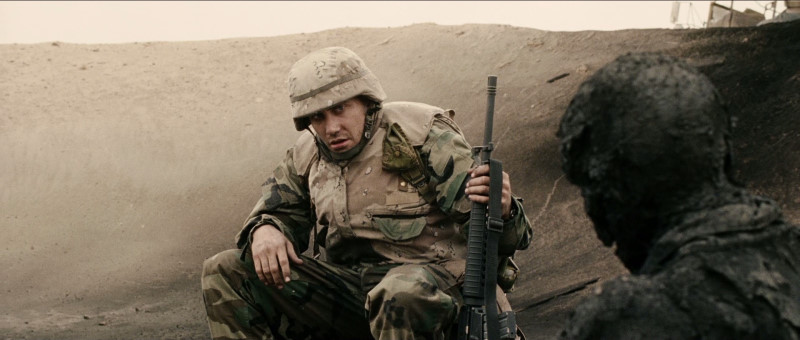
War is boring as hell. It consists of masturbation, dehumanising an unseen enemy, the fear of what those left at home are doing, more masturbation, cleaning your weapons, endless uncertainty and waiting. Jarhead is a film about war with very little combat and it is also about the mind of a soldier. It is a film resplendent in Sam Mendes' quiet artfulness and Roger Deakins' colourful, handheld cinematography, and a script about people who volunteer to become psychologically damaged, with absorbing performances from its leads.

 Jake Gyllenhaal plays Private Anthony Swofford in Sam Mendes' adaptation of the memoirs of the real life Swofford, a veteran of the first Gulf War. Swofford's uncle and father both served in Vietnam, and the vast gulf of difference between his experiences in the Marines and those of his family comes as a great shock. However, Jamie Foxx's Staff Sergeant Sykes soon recruits both Swofford and Troy (Peter Sarsgaard) to become Scout Snipers. Swofford is consumed by the power and prestige of being a sniper, and captivated by the philosophy of the one perfect moment when an enemy in his cross-hairs. After the Gulf War is declared, his unit is sent to defend oil reserves in the Saudi desert, though the lack of combat and formidable desert climate begin to take their toll on the young men.

Jarhead's world of over-whelming ultra-masculinity and reshaping of language into military distinctions contributes into its message about how war changes people, specifically in a war that's unlike many others. It establishes and reinforces that the psychological effects of war on soldiers goes beyond just the brutality of battle and a hostile training regime. With few fronts, and an almost inhospitable setting, the realities of the Gulf War clash tremendously with the expectations of the recruits, and the results of their training. Swofford is obviously influenced by the romantasiced Great Wars, and by the Vietnam War, which had an entirely different enemy, motive, and result. The Vietnam War was also the first televised war, and one where the transformative psychological impact of the conflict because common knowledge, whether that was the training methods, the combat, the weapons used, or the reception when Western soldiers returned home. In contrast, the characters of Jarhead are almost convinced that by waging war against a despot, they can win a romantic war with the modern attitude of a post-Vietnam United States Army.

.But the uniqueness of their situation becomes increasingly blatant, as the advanced state of the American war machine in contrast to the war in Vietnam puts a new burden on the men. As Sarsgaard's Troy says "This war is going to move too fucking fast for us. We can shoot a thousand yards. To go that far in Vietnam, it'd take a week. In World War One, a year. Here, it's gonna take about ten fucking seconds! By the time we have our rifles dialed the war is gonna be a mile down the road." The film makes the point that men are changed not just by the war itself, but by the lifestyle of being a soldier. Language changes, the consistensies of home change, the very land you live on changes, all at a moments notice, They are mentally and physically separate from the people they are defending, and the pain this causes can be justified if they can kill the enemy. Swofford poetically evokes this with the narrated line "The man's hands remember the rifle." And a state of absurdly overbearing  masculinity becomes the social norm in the separate world. Fitness, aggression, semi-mocking homo-eroticism, and all-consuming phallic power are the tenents of this war's culture. These are men who have had all of their desires pinned onto a single act, the act of killing the enemy. Any time they are denied that, their worth is diminished, and with it their psyche.


                                          "Every war is different. Every war is the same."


In Jarhead, music is used less often to fill the sound of scenes but rather to bridge them in concert with the editing. This is a technique that gives a timeless quality in direct contrast to the titled "Time in desert" that appears on-screen.  Roger Deakins most often uses steadicam that, alongside the direct though poetic narration, implants the audience as a silent accomplice to the madness on-screen. Mendes first gained notoriety for his artful tale of suburban lusting American Beauty, but in 2012's Skyfall he also showed that he can take a film that usually exists within a certain style or genre and recontextualise it into a something more directly colourful, artistic and psychologically dense. Though Jarhead is more comparable to David O'Russell's Three Kings in setting and colour grading, the use of lighting, psychology and visual metaphors for mentally broken men creates a bridge between two of Mendes' most mainstream and action-filled films. And William Broyles, Jnr's script helps in no small part. Gyllenhaal ranges from dead-eyed detachment to horrifically honest breakdowns that really show his ability, at a time when he was still a rising star. Sarsgaard and Sykes certainly rise up in great support of Gyllenhaal's lead, but the three are certainly distinct from their enjoyable, though one-note support cast. One's an arsehole, one's a dork, one's a Latino family-man, and none are surprising.

Jarhead is perhaps a forgotten gem in the wake of countless 21st century war dramas that are set in the Middle East, but there is certainly plenty to be found. A good script, some excellent performances and direction, and even effective use of Kanye West's music.

Jasper Roberts Consulting - Widget