Showing posts with label Sam Mendes. Show all posts

Wednesday, 18 November 2015

Spectre

In the beautiful secrecy of Rome at night James Bond arrives at a secret meeting. Uninvited he smirks his way past the guards in Craig's now signature brutish fashion. As he arrives in the upper gallery viewing deck of this clandestine conglomerate, he makes his way through the witnesses looking down at a vast hall wherein an international assortment of organised crime discusses business. The lighting is low and reflective of the power and secrecy of this event, the sound echoes in the cavernous gloom as Bond stalks silently between faces cloaked in darkness. Suddenly the arrival of a shadowy man in the meeting creates a palpable atmosphere of fear within the cavernous hall. Within minutes a man is killed and no one moves a muscles. The recent arrival. surely the head of this cabal speaks into the microphone. Bond is enamoured, captivated by this man and his power. The man makes a public address to everyone in the room but it seems he has one particular person as his intended audience. "Welcome, James. What took you so long?" The man turns and looks up into the gallery, make direct and immediate eye contact with Bond. The light captures his face, Bond knows this man.


With 2012's Skyfall director Sam Mendes furthered the modern Bond revival with it's stylish action and settings, breath-taking cinematography, retro-appeal and personal storyline. But with Spectre, all the goodwill of Skyfall seems to be slowly bleeding out of a film that too doggedly holds onto contemporary blockbuster ideas on stakes and motivation, and classic Bond nostalgia. The effect being a mixed bag of the good, the bad and the ugly of Bond. Spectre begins with a lovely but needlessly showy (seemingly) single-take shot in Mexico City during Day of the Dead with Bond on the trail of a bad guy. After the event naturally ends in a helicopter fist-fight metres above the streets of Mexico City and Bond killing his target he's left with naught but a strange silver ring whose only distinction is a black octopus engraving. It turns out Bond has gone somewhat rouge after receiving a tape from the now deceased Judy Dence M and without approval from the new M (Ralph Fiennes) goes in search of the men who sent Skyfall's villain Raoul Silva, which turns out to be the eponymous committee. Along the way Bond is surreptitiously joined by Moneypenny (Naomie Harris), Q (Ben Whishaw) and Madeline Swann (Lea Seydoux), a woman with an mysterious link to the organisation and a prime target for them.

Spectre is a lovely film for the most part, fulfilling in all the necessary requirements for a Bond film, beautiful women, beautiful cars, seduction, varied scenery, vodka martini's. secret bases, ridiculous fun action and villains, villains, villains galore. But the whole way through the film just feels off. Motivations are lacking, plot-holes are apparent and a general sense of dualism is present, the film is never sure if it should be a throwback or re-invent the wheel and is seemingly stuck between the two points. In spite of the brilliant and armour-cracking portrayal of the aging, bitter Bond during Skyfall and the surely tragic death of M, Craig has perfected the formula for his Bond in this film. He's strong, silent, smarmy, apparently suave and frankly brutish, and in possibly the most satirical take on Bond's persona after killing an Italian bad guy in Mexico, he goes to the man's funeral, meets his wife, saves her from assassination, fucks her on the night of her husbands funeral and she is gotten by the next scene. It's enough to make even the most casual Bond fan ache for the bravery to return to a campy Bond with torturous puns.

Though the film is surely competent and interesting enough it's the bad that draws the attention after the objectively enjoyed Casino Royale and Skyfall, and (perhaps over-criticised Quantum of Solace). The reveal of Bond's connections to arch-villain Oberhauser are lazy as they are stupid (SPOILER ALERT), Oberhauser's plan is needless, and the whole thing smacks of prequel-level writing in the need to bring things to a certain point. Madeline Swann is one of the most disappointing Bond women in a good while and the romance between her an Bond is nothing short of tacky, there is absolutely no reason these people should be together whatsoever. Finally, the finale is derivative, lazy, blockbuster trash, with a few genuinely interesting moments, but hampered by senselessness and carelessness. Overall, Spectre is a hot mess, when it does well, it can be lovely, but overall it's just an unpleasant odour that lasts for two-and-a-half hours. While not bad, it's certainly a film that will become less appealing the more one applies thought and time to it.

Wednesday, 28 January 2015

Classic Movie Review: American Beauty (1999)

"Look Closer" - The tag line for Sam Mendes' directorial debut American Beauty, is a perfect descriptor for a film that gazes beyond the materialism of American suburbia, to present a portrait of love, confusion, obsession, voyeurism and a cynical man that will have you in stitches on every viewing.

 Lester Burnham (Kevin Spacey) is a middle-aged, middle-class American, sedated by the state of his life. He describes his morning masturbatory session as the highlight of his day, "It's all downhill from here". Lester's wife, Carolyn (Annette Bening) is an ambitious real-estate agent who seems to have little time for Lester, or their daughter Jane (Thora Birch), a self-conscious teenager who distances herself from her parents.  

 One evening, at a high school basketball game, Jane and her friend Angela (Mena Suvari), a self-obsessed girl, driven by popularity, participate in a cheer-leading routine. Lester, who's in the audience, suddenly becomes fixated on Angela, fantasizing about a sexual encounter with her. Lester's crush on Angela rejuvenates his drive, and sees him quit his job, get fit, and trade his Toyota Camry for his favorite sports car. A new family moves in next to the Burnham household, a disciplinarian, Colonel Fitts (Chris Cooper) with a subdued son, Ricky (Wes Bentley). Ricky takes an interest in Jane, filming her in a perverse manner, though this is perhaps the first time that anybody has taken an interest in Jane.

Like another film of its era, David Fincher's Fight Club, American Beauty is pessimistic about the effects of consumerism and the emasculation of men in such a society, but instead of presenting this viewpoint through an obsessively dark world, Mendes creates an overly-bright neighborhood, almost like a model-town in its repetitive, flawless construction. The Burnham family house is white with shades of blue and red, a recurring colour palette in the film. The petals that fall in Lester's fantasies are as impeccably red as Carolyn's "eggshells and Miracle Gro" roses. Lester remarks in his opening monologue about how the handles of his wife's pruning shears perfectly match her gardening clogs. "That's not an accident". He's a man trapped in a clichéd suburbia and suppressed by his shallow yet ambitious wife. The brand of dark humour that inhabits Lester's dialogue is a crucial, binding element that runs through the film. Without the snide comments that Lester jovially commentates to the audience, the film would lose its central personality, something which is specifically lacking in Lester's world.

American Beauty is the first of two collaborations between Mendes and prolific cinematographer Conrad Hall (the other being Road to Perdition), both films have similar artistic concerns, but they function best here, in a script full of personal fantasies and stylised realities. Hall utilises fluid camera movements, with extreme closeups and clever angles to bring Lester’s feelings of suppression to the forefront. The fantasy scenes are composed of bright, often angelic lighting and repetitive cuts, all of which form the unique style of Hall’s composition. The  film is accompanied by a memorable and very percussive score by Thomas Newman, another frequent collaborator of Mendes. The framing denotes Mendes’ theatre background, with long static shots, such as the ones at the Burnham’s dinner table, used to create distance between the characters. Mendes also put the actors through weeks of practice (typical of the theatre), which helped them to bond with each other and their characters.

Kevin Spacey is the core reason that I love this film. His portrayal of Lester's transformation from docile to driven is among the best on-screen rebirths, and his asides never fail to amuse me. Annette Benning takes an almost unlikable character and manages to draw a huge amount of empathy from the audience. You genuinely feel sorry for her by the end, for many different reasons. Birch provides a very mature performance for her age and forms Jane into a difficult-to-read but complex person. All the other supporting roles are very good, especially Allison Janney, who conveys the tragic nature of Barbara in the few words that she utters.

Whenever I discuss American Beauty with someone, it tends to be a polarised conversation. This seems to be a movie that you either love or you hate. It could certainly be argued that it's too steeped in its own symbolism, that it metaphorises everything to death. But its denouncement of a consumerist society through what is, in many ways, a lighthearted and almost mocking style, has always been endearing to me. The tongue in cheek humour, unique look, memorable characters and fantastic delivery from Spacey has left American Beauty perched atop my favourite movies for many years now, and it’ll take a lot to dethrone it.

Wednesday, 24 December 2014

War Movie Month: Jarhead (2005)


"You are no longer black or brown or yellow or red. You are now green! You are light green or dark green, do you understand?"

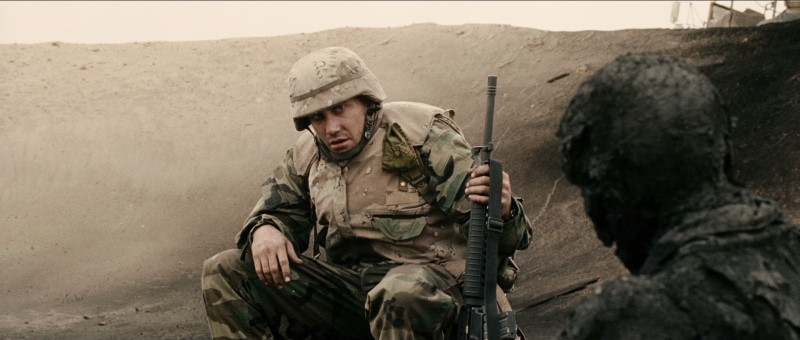
War is boring as hell. It consists of masturbation, dehumanising an unseen enemy, the fear of what those left at home are doing, more masturbation, cleaning your weapons, endless uncertainty and waiting. Jarhead is a film about war with very little combat and it is also about the mind of a soldier. It is a film resplendent in Sam Mendes' quiet artfulness and Roger Deakins' colourful, handheld cinematography, and a script about people who volunteer to become psychologically damaged, with absorbing performances from its leads.

 Jake Gyllenhaal plays Private Anthony Swofford in Sam Mendes' adaptation of the memoirs of the real life Swofford, a veteran of the first Gulf War. Swofford's uncle and father both served in Vietnam, and the vast gulf of difference between his experiences in the Marines and those of his family comes as a great shock. However, Jamie Foxx's Staff Sergeant Sykes soon recruits both Swofford and Troy (Peter Sarsgaard) to become Scout Snipers. Swofford is consumed by the power and prestige of being a sniper, and captivated by the philosophy of the one perfect moment when an enemy in his cross-hairs. After the Gulf War is declared, his unit is sent to defend oil reserves in the Saudi desert, though the lack of combat and formidable desert climate begin to take their toll on the young men.

Jarhead's world of over-whelming ultra-masculinity and reshaping of language into military distinctions contributes into its message about how war changes people, specifically in a war that's unlike many others. It establishes and reinforces that the psychological effects of war on soldiers goes beyond just the brutality of battle and a hostile training regime. With few fronts, and an almost inhospitable setting, the realities of the Gulf War clash tremendously with the expectations of the recruits, and the results of their training. Swofford is obviously influenced by the romantasiced Great Wars, and by the Vietnam War, which had an entirely different enemy, motive, and result. The Vietnam War was also the first televised war, and one where the transformative psychological impact of the conflict because common knowledge, whether that was the training methods, the combat, the weapons used, or the reception when Western soldiers returned home. In contrast, the characters of Jarhead are almost convinced that by waging war against a despot, they can win a romantic war with the modern attitude of a post-Vietnam United States Army.

.But the uniqueness of their situation becomes increasingly blatant, as the advanced state of the American war machine in contrast to the war in Vietnam puts a new burden on the men. As Sarsgaard's Troy says "This war is going to move too fucking fast for us. We can shoot a thousand yards. To go that far in Vietnam, it'd take a week. In World War One, a year. Here, it's gonna take about ten fucking seconds! By the time we have our rifles dialed the war is gonna be a mile down the road." The film makes the point that men are changed not just by the war itself, but by the lifestyle of being a soldier. Language changes, the consistensies of home change, the very land you live on changes, all at a moments notice, They are mentally and physically separate from the people they are defending, and the pain this causes can be justified if they can kill the enemy. Swofford poetically evokes this with the narrated line "The man's hands remember the rifle." And a state of absurdly overbearing  masculinity becomes the social norm in the separate world. Fitness, aggression, semi-mocking homo-eroticism, and all-consuming phallic power are the tenents of this war's culture. These are men who have had all of their desires pinned onto a single act, the act of killing the enemy. Any time they are denied that, their worth is diminished, and with it their psyche.


                                          "Every war is different. Every war is the same."


In Jarhead, music is used less often to fill the sound of scenes but rather to bridge them in concert with the editing. This is a technique that gives a timeless quality in direct contrast to the titled "Time in desert" that appears on-screen.  Roger Deakins most often uses steadicam that, alongside the direct though poetic narration, implants the audience as a silent accomplice to the madness on-screen. Mendes first gained notoriety for his artful tale of suburban lusting American Beauty, but in 2012's Skyfall he also showed that he can take a film that usually exists within a certain style or genre and recontextualise it into a something more directly colourful, artistic and psychologically dense. Though Jarhead is more comparable to David O'Russell's Three Kings in setting and colour grading, the use of lighting, psychology and visual metaphors for mentally broken men creates a bridge between two of Mendes' most mainstream and action-filled films. And William Broyles, Jnr's script helps in no small part. Gyllenhaal ranges from dead-eyed detachment to horrifically honest breakdowns that really show his ability, at a time when he was still a rising star. Sarsgaard and Sykes certainly rise up in great support of Gyllenhaal's lead, but the three are certainly distinct from their enjoyable, though one-note support cast. One's an arsehole, one's a dork, one's a Latino family-man, and none are surprising.

Jarhead is perhaps a forgotten gem in the wake of countless 21st century war dramas that are set in the Middle East, but there is certainly plenty to be found. A good script, some excellent performances and direction, and even effective use of Kanye West's music.

Friday, 5 December 2014

The New James Bond Movie has been announced!

Some very exciting news has just been announced. Director of Skyfall Sam Mendes made the announcement on Thursday from Pinewood Studios (the home of James Bond) that the new Bond movie will be called Spectre.

Fans of the Bond series will instantly recognise what this title alludes to. SPECTRE (standing for Special Executive for Counter-intelligence, Terrorism, Revenge and Extortion) was the organisation that Bond was a constant foil to in the early movies, especially the Connery years. This organisation was headed by the ever-changing and mysterious Ernst Stavro Blofeld.

Before you get excited thinking that we are seeing the return of Blofeld, it has been announced also that Christoph Waltz will play the villain Oberhauser, the son of the late Hans Oberhauser, a man who acted as a father figure for Bond. This sounds like a whole bunch of misdirection to me. Remember when they said that Benedict Cumberbatch WASN'T playing Khan Noonien Singh in Star Trek Into Darkness.

In addition to Waltz, the new cast members will include Lea Seydoux, Dave Bautista, Monica Bellucci and Andrew Scott. Returning from Skyfall are Ralph Fiennes as M, Ben Whishaw as Q, Naomie Harris as Miss Moneypenny and Rory Kinnear as Tanner. All more I can say is that we here at the blog are more excited than we have ever been.
Jasper Roberts Consulting - Widget