Showing posts with label Jamie Foxx. Show all posts

Wednesday, 24 December 2014

War Movie Month: Jarhead (2005)


"You are no longer black or brown or yellow or red. You are now green! You are light green or dark green, do you understand?"

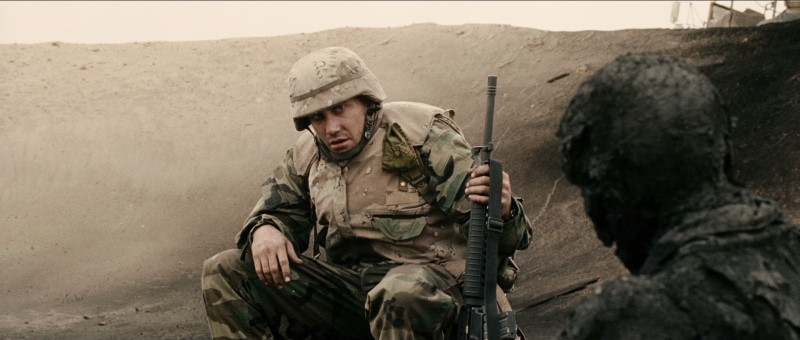
War is boring as hell. It consists of masturbation, dehumanising an unseen enemy, the fear of what those left at home are doing, more masturbation, cleaning your weapons, endless uncertainty and waiting. Jarhead is a film about war with very little combat and it is also about the mind of a soldier. It is a film resplendent in Sam Mendes' quiet artfulness and Roger Deakins' colourful, handheld cinematography, and a script about people who volunteer to become psychologically damaged, with absorbing performances from its leads.

 Jake Gyllenhaal plays Private Anthony Swofford in Sam Mendes' adaptation of the memoirs of the real life Swofford, a veteran of the first Gulf War. Swofford's uncle and father both served in Vietnam, and the vast gulf of difference between his experiences in the Marines and those of his family comes as a great shock. However, Jamie Foxx's Staff Sergeant Sykes soon recruits both Swofford and Troy (Peter Sarsgaard) to become Scout Snipers. Swofford is consumed by the power and prestige of being a sniper, and captivated by the philosophy of the one perfect moment when an enemy in his cross-hairs. After the Gulf War is declared, his unit is sent to defend oil reserves in the Saudi desert, though the lack of combat and formidable desert climate begin to take their toll on the young men.

Jarhead's world of over-whelming ultra-masculinity and reshaping of language into military distinctions contributes into its message about how war changes people, specifically in a war that's unlike many others. It establishes and reinforces that the psychological effects of war on soldiers goes beyond just the brutality of battle and a hostile training regime. With few fronts, and an almost inhospitable setting, the realities of the Gulf War clash tremendously with the expectations of the recruits, and the results of their training. Swofford is obviously influenced by the romantasiced Great Wars, and by the Vietnam War, which had an entirely different enemy, motive, and result. The Vietnam War was also the first televised war, and one where the transformative psychological impact of the conflict because common knowledge, whether that was the training methods, the combat, the weapons used, or the reception when Western soldiers returned home. In contrast, the characters of Jarhead are almost convinced that by waging war against a despot, they can win a romantic war with the modern attitude of a post-Vietnam United States Army.

.But the uniqueness of their situation becomes increasingly blatant, as the advanced state of the American war machine in contrast to the war in Vietnam puts a new burden on the men. As Sarsgaard's Troy says "This war is going to move too fucking fast for us. We can shoot a thousand yards. To go that far in Vietnam, it'd take a week. In World War One, a year. Here, it's gonna take about ten fucking seconds! By the time we have our rifles dialed the war is gonna be a mile down the road." The film makes the point that men are changed not just by the war itself, but by the lifestyle of being a soldier. Language changes, the consistensies of home change, the very land you live on changes, all at a moments notice, They are mentally and physically separate from the people they are defending, and the pain this causes can be justified if they can kill the enemy. Swofford poetically evokes this with the narrated line "The man's hands remember the rifle." And a state of absurdly overbearing  masculinity becomes the social norm in the separate world. Fitness, aggression, semi-mocking homo-eroticism, and all-consuming phallic power are the tenents of this war's culture. These are men who have had all of their desires pinned onto a single act, the act of killing the enemy. Any time they are denied that, their worth is diminished, and with it their psyche.


                                          "Every war is different. Every war is the same."


In Jarhead, music is used less often to fill the sound of scenes but rather to bridge them in concert with the editing. This is a technique that gives a timeless quality in direct contrast to the titled "Time in desert" that appears on-screen.  Roger Deakins most often uses steadicam that, alongside the direct though poetic narration, implants the audience as a silent accomplice to the madness on-screen. Mendes first gained notoriety for his artful tale of suburban lusting American Beauty, but in 2012's Skyfall he also showed that he can take a film that usually exists within a certain style or genre and recontextualise it into a something more directly colourful, artistic and psychologically dense. Though Jarhead is more comparable to David O'Russell's Three Kings in setting and colour grading, the use of lighting, psychology and visual metaphors for mentally broken men creates a bridge between two of Mendes' most mainstream and action-filled films. And William Broyles, Jnr's script helps in no small part. Gyllenhaal ranges from dead-eyed detachment to horrifically honest breakdowns that really show his ability, at a time when he was still a rising star. Sarsgaard and Sykes certainly rise up in great support of Gyllenhaal's lead, but the three are certainly distinct from their enjoyable, though one-note support cast. One's an arsehole, one's a dork, one's a Latino family-man, and none are surprising.

Jarhead is perhaps a forgotten gem in the wake of countless 21st century war dramas that are set in the Middle East, but there is certainly plenty to be found. A good script, some excellent performances and direction, and even effective use of Kanye West's music.

Thursday, 18 December 2014

Annie


              Stacks: "I've learned you can count the people who truly love you on one hand."
              Annie: "You know you're making a fist, right."

What is Annie? It's a modernised update of the classic stage musical, made for the children of 2014. Set in New York City, specifically Harlem. The race of the leads are inverted to, along with excessive producer credits that include two hip-hop stars (Will Smith and Jay-Z) and Jada Pinkett-Smith, give the impression that this movie has the appeal and feel of a Tyler Perry or Oprah Winfrey production, or one of those Ja-Rule movies (a.k.a often bad and intended for black audiences only). With a script by the writers of Friends with Benefits, Morning Glory, 27 Dresses, We Bought a Zoo, Fired Up! and The Michael J. Fox Show. Directed by the man who directed Fired Up!, Friends with Benefits, Easy A and was the creator/executive producer of the Michael J. Fox show. And with a trailer for such a film it's hard not to walk in to this childless and not be full of a passionate, frothing hatred and the expectation to be delighted by the shoddyness on-screen. But like the titular little "foster care kid", Annie is not as awfully annoying as it would seem.


In Harlem, the precocious and eponymous orphan (Quvenzhane Wallis) lives with four other "foster care" children, waiting and wishing to be adopted and saved from the hammy Cruella-DeVille-ing of Cameron Diaz's Miss Hannigan, an alcoholic and abusive spinster who denigrates the chirpy young girls, and occasionally drunkenly smacks their heads into walls. Annie visits the same restaurant every Friday night as it is the only clue to her patronage, but otherwise spends her time at school, running about the neighbourhood, or cleaning her foster home. While trying to protect a Shiba Inu doge from some boys who are throwing cans at it, she is saved from a speeding van by billionaire mobile phone mogul Will Stacks (Jamie Foxx). Stacks is in the middle of a mayoral election campaign, but losing to a man who talks about being pissed on during a kids film ("Don't pee in my ear and tell me it's hot rain"). So Stacks, his British assistant Grace (Rose Byrne) and fast-talking money-loving adviser Guy (Bobby Canavale) intend to exploit the humanity the young girl gives him to win votes, and he soon invites her to live with him for a while. During her stay the two bond and learn off of each other, most often Stacks learning that there is more to life than hard work and business.


Annie has a certain precocious charm to it, though this is surrounded by discussions of political campaigns, phone mechanics, wildly inappropriate jokes about prostitution, alcoholism and abandonment, and such inexplicable marginalisation of real issues such as alcoholism, domestic abuse, abandonment and repression that its baffling to see these details even present in what is intended to be a sweet childrens musical, let alone being mocked. There's also many references to actors and pop culture that's fine for older audiences, including a Young Adult film-adaptation parody featuring Ashton Kutcher and Mila Kunis and a political ad featuring Michael J. Fox. You know, jokes for children. Chuck in a  Deliverance joke while you're at it.


"No, thanks. I don't want....companionship. Not that I'm judging!"
Literally a line of dialogue in this childrens film.


Quvezhane Wallis is undeniably great in the lead role. She's smart-mouthed, but innocent enough to be completely endearing, and possibly the best thing to say about the film as a whole. Jamie Foxx is serviceable, Rose Byrne is Rose Byrne (solid and sweet), but the hammyness of Bobby Canavale and Cameron Diaz meanders between entertaining and cringe-worthy, and often distracts. Visually, the film is bubbly and bright, but otherwise unremarkable. The musical side of the film is presented as self-aware, during several songs characters often react with bemusement, astonishment and/or scorn when others launch into song, but this just invites the wish for more confused reaction shots of bystanders during these musical numbers. The songs themselves are apparently mildly updated versions from the stage-play, with some being dropped completely to meet pacing and narrative requirements. Also, the occasional remixing of a song can be pretty startling (Foxx's rendition of "The City's Yours" featuring an interminable R&B backing). The film certainly falters in the third act,  devolving into tying loose ends where character arcs should be, and a boring chase involving Twitter and Instagram. It actually makes you miss the archetypal end of second act break-up moment that appears in most childrens films, which is followed by a sweeping crescendo of a reunion. But hey, it's a hard knock life.


Annie is not a cinematic movie, but will be an enjoyable enough DVD to pop on for the kids on a lazy weekend. None of the songs will stick, and neither will the performances outside of Diaz, Canavale and especially Wallis. Not as bad as it deserves to be, but nothing work making a fuss over, really.


Sunday, 14 December 2014

Horrible Bosses 2

The original Horrible Bosses was an enjoyable film with a great cast, but apart from perhaps 22 Jump Street, comedy sequels don't tend to have a great track record. Inevitably, Horrible Bosses 2 has come along, this time under the direction of Sean Anders. Is it a film destined to be a classic? Or is it likely to be as graceful as a plane crash? Let's check it out.

After the events of the first film, Nick (Jason Bateman), Kurt (Jason Sudeikis) and Dale (Charlie Day) decide to form their own business, centred around their invention, the shower buddy. The company, erroneously named 'Nick-Kurt-Dale' (say it quickly for the first racist joke of the film), are approached by Rex (Chris Pine) and his father, Burt Hansen (Christoph Waltz), the owner of a large retail chain. After Burt stabs them in the back, the trio decide that their best course of action is to kidnap Rex and ask for a ransom.

After that plan typically fails, they find themselves partnered up with Rex, who also has a motive for getting the ransom from his father. They brainstorm an outlandish kidnapping plan that sets in motion the rest of the events of the film. Along the way, several characters from the original are reunited with the trio, including the now incarcerated 'horrible boss', David Harken (Kevin Spacey), the sex addict dentist, Julia (Jennifer Aniston) and Dean "Motherf*cker" Jones (Jamie Foxx), in a sequel that seems incapable of differentiating itself from many other comedies of recent years.

Similar to the first, almost all of the jokes in Horrible Bosses 2 are incredibly crude. Be it sex, masturbation, 'toilet humour', or just swearing for giggles, they generally lack taste. There's something quite charming enjoyable about that sort of humour, but the problem in this case is that the jokes seem so tired that they're really quite hit and miss. 

Though the wit can be somewhat forgiven thanks to the incredible follow-up cast. The returning trio seem to have lost none of the chemistry from the original and many of the returning cast members, including Aniston & Foxx are just as fantastic as in the first. As for Kevin Spacey, well, his two short appearances are the best scenes in the film. New to the series are Chris Pine and Jonathan Banks, both putting in great performances, the latter holding the same hilarious gravitas as he did as Mike in Breaking Bad. The only slight disappointment (mainly due to script) was Christoph Waltz, who's character doesn't really get many jokes so ends up being a bland placeholder in the overall plot.

The heist-like kidnapping scenes make for some fantastic sequences from cinematographer Julio Macat (Home Alone, Wedding Crashers) which really do elevate the entertainment value of the film. With fast paced tracking shots, car chases and some cool edits, they bring more to the series than the first, which was visually, a straight-forward comedy. 

Horrible Bosses 2 has an incredibly strong cast and is visually quite compelling. It's full of hilarious moments that are dark and crude in a similar fashion to the first, but unfortunately there are many, many other moments which are in bad-taste and are too overused to amuse.


Tuesday, 22 April 2014

The Amazing Spider-Man 2

I am still undecided in my feelings toward the newest iteration of the Spider-Man film franchise. He is my favourite superhero and I grew up with the Sam Raimi/Tobey Maguire films. I loved those movies as a teenager because they had all the things a Spider-Man film needed. When the first of these new films came out, I was very reluctant to see it because I didn't know what they could change from before. I watched that film a week ago, so that I could understand the new angle that was being put forth and I wasn't blown away or disappointed by the film but I understood the new direction. That way was toward the comics on which it was based.

Of course there are a lot of things that has been created for the films, but the character of Peter Parker is much more like in the comics. Andrew Garfield (The Social Network) trash talks the perps he is chasing. He is fun and bubbly when he is in the suit and moody when he isn't. One aspect that Garfield doesn't really portray is the nerdiness that comes with Peter Parker, a trait that Maguire had down-pat.

In this film Peter's relationship with his girlfriend Gwen Stacy (Emma Stone) is pushed to the limit, as Spidey promised her dying father that he wouldn't let any harm come to her. That is a one of the big themes in this film; Peter's relationships with all the other characters, whether as Peter or Spider-Man.

Of course this film also has some action in it, with some new villains as well as a new twist on an old favourite. First up is Jamie Foxx as Electro, a former Oscorp employee who gains electrical powers after an accident involving some electric eels. His genesis was very reminiscent of one of the Batman movies of the 90s, the villains were always falling in toxic chemicals back then. I feel as though Foxx wasn't able to flex his acting prowess in this film, rather just shouting through every scene.

I was also disappointed with the inclusion of Paul Giamatti as Aleksei Sytsevich or The Rhino. He appears only briefly in the film at both the beginning and the end and is underused completely, especially having such a fantastic actor as Giamatti playing him. My only hope is that he makes another appearance in the next film.

James Franco did such an amazing job as Harry Osborn and was such a good character in all three films, so I was understandably shocked with Dane DeHaan's amazing portrayal of the character. Harry is dying of a rare genetic disease which he inherited from his father Norman (Chris Cooper) and believes that Spider-Man's blood will save him. This is where the plot gets too convoluted for me. (Also quick side note before I go on, who thought it was a good idea to cast Chris Cooper as Norman Osborn. Willem Dafoe is the only person who should ever play that character).

Now, the convoluted plot elements come from including Richard and Mary Parker, Peter's parents, in this film. (Also isn't Richard Parker a tiger, or did Spidey's dad come first?) I understand putting them in the first film to make sense of Peter's relationship with The Lizard, but in this one it really just slows down the pace. There is one scene between Peter and Aunt May where bringing up his parents is needed, but that's it.

Verdict: I am still unsure what the point of having this new series of films is or what it's leading to, but these need to get a little better in the story department. We needed to see more of the Green Goblin and Rhino in their suits.

Wednesday, 30 January 2013

Django Unchained

I remember on my first day of film school, one of my teachers asked me what I wanted to be in the
industry. When I replied that I wanted to be a director, he preceded to ask me who was my favourite. I said Tarantino, because like most young filmmakers my age, he was one of the people who inspired me to get into film. He then started to mock me for being inspired by a man who was incapable of being original and someone who stole scenes from other films. In my own naive way I thought this to be true, but as I saw more and more films by other directors I realised that everyone makes homages to their favourite films and filmmakers. But it isn't until now that I feel fully vindicated. Of course after my dressing down in front of the class, my newfound friends all told me they liked Tarantino as well. So, the reason for my vindication, you might ask, is Quentin Tarantino's Django Unchained. And that is because this movie is a movie that covers such a controversial, heart wrenching topic that affects the majority of the population of the US.

The movie follows the story of the titular Django (Jamie Foxx), who is sought out by the cunning bounty hunter Dr. King Schultz (Christoph Waltz) to help in discover the whereabouts of three of his targets, in return Django will earn his freedom. As they move on and Dr. Schultz trains Django as his protege and they embark on numerous bounties, we find out that Django's wife, Broomhilda (Kerry Washington), was sold to someone different to Django as punishment for running away. Dr. Schultz agrees to help Django find his bride. She is being held at Candyland and her master is the downright evil Calvin Candie (Leo DiCaprio), a francophile who doesn't speak a word of French. Dr. Schultz and Django concoct a master plan to get Broomhilda to safety and the film ends in classic Tarantino style (going into any further depth on the plot would just be unfair).

Tarantino has said that there is something for everyone to hate in this film and I have never heard a truer statement. Whether it be the stylised but gratuitous violence, the overuse of one of the worst racial slurs one can utter (although in the context of 1858, that overuse is understandable) or the graphic depiction of the punishment of slaves (which is the one that wrenched at me) there really is something for everyone to wince at.

Also there is not a single weak performance in this movie. Everyone is exemplary. Jamie Foxx should win an award, any award for his performance. Django is a sympathetic character who you hope everything comes good for. I haven't seen Christoph Waltz in anything since his depiction of sadistic SS Colonel Hans Landa in Tarantino's previous effort Inglorious Basterds. Dr. King Schultz couldn't be further away from Landa. Even though he is in effect a glorified assassin, he is still a friendly and affable character, that's of course if you're not one of his targets. The stunning Kerry Washington is unfathomably fantastic as Broomhilda. She is obviously loved a lot by Django and in return she loves him in equal amount. One of the scenes which disturbed me most involved her being released from a hotbox, which I can only imagine was a punishment for slaves in that time.

And then on the other side of the coin we have the heinously evil Calvin Candie and his manservant, Stephen, played respectively by Leo DiCaprio and Samuel L. Jackson. DiCaprio's performance as such a despicable character renders him so completely unnoticeable from any of his previous roles. There is one scene where he smashes a glass with his hand and suffers quite a bad cut, but the character keeps going. Sam Jackson is just as excellent as the devious Stephen, who orders the slaves around like he is their master. There are also a huge number of cameos by respected actors from around the globe, but they are too numerous to mention one by one.

Verdict: This film is an epic sprawling across the southern states. It is also classic Tarantino and probably the best film of his career. A must-see.

Jasper Roberts Consulting - Widget