

"You're gonna die on this mountain and I'm gonna laugh when you do!"
Quentin Tarantino is on a mission to save film and in his eye true cinematic experiences in concert with his stead-fast dedication to the superiority of analogue film are the purifying force destined to save proper analogue film from the ravenous, convenient beast of digital. The Hateful Eight is filmed on Ultra Panavision 70, a stock not used supposedly since the mid-60's and even then only on the most epic event cinematic experiences. and that is the intent of the Hateful Eight in general, and the Roadshow production in particular. The Roadshow production not only presents the film in the crisp and super-wide 70mm, but allows extra time before the film starts to set the tone with a near operatic overture and divide the film's epic run-time with a brief intermission. In many more ways The Hateful Eight is established as an event, intended to be a one-off stage-reading, filmed in 65mm and presented on 70mm, featuring an ensemble cast of characters actors all over forty years old in a single-location cross-genre-film led by a prolific writer-director, in no way can this construed as your average cinematic experience.
While John"The Hangman" Ruth (Kurt Russell) attempts to transport his bounty, Daisy Domergue (Jennifer Jason Leigh) to Red Rock, Wyoming with a blizzard on in his coach's tail he happens upon a stranded Major Marquis Warren with several corpses of his own bounty. Warren, a veteran of the Civil War, is a colleague of sorts with Ruth and is able to hitch a ride to Red Rock so much as they respect each others bounties. Along the way they pick up another stranded man, former Confederate and new Red Rock Sheriff Chris Mannix (Walton Goggins) before seeking shelter from the blizzard in Minnie's Haberdashery, a small stable and all-purpose by-way on the road to Red Rock. Inside they find the bitter Confederate General Sandy Smithers (Bruce Dern), cow puncher Joe Gage (Michael Madsen), the Mexican Bob (Demian Bichir, and the British Little Man Oswaldo Mobray (Tim Roth). In keeping with Tarantino's style, this meeting runs amok with violence, sweaing and simming tensions coming to a boil.
Quentin Tarantino may have started his career with gangster/crime films, but its the Western that truly allows his style to flourish and settle at the same time. The opportunities to stylise and homage come frequently, while the genre conventions and reputation allow for Tarantino's signature scenes to feel so welcome, almost at home. The Western gives Tarantino the space to build tension, narrative and character at whichever pace he chooses and though the violence may be played to cartoonishly gory and humourous affect, it's expected, even warranted. As is the notion that this entire batch of characters is in some way or another loathsome or antagonistic. They beat, swear, belittle and mock each other, most are in no way trustworthy, and the subsequent violence that erupts never once attempts to make one character noble nor another tragic, but their death and killer both funny. Heads and testicles explodes, squips explodes and blood flies, and the deadpan approach to violence and death is in keeping with the setting.

A lot has been and will continue to be discussed about the racial and gendered attitudes within Tarantino's films as a whole and his westerns in particular, and perhaps Tarantino's making a larger point about films at large. I both cannot and will not discuss these issues in depth as its not really my place to but I will note how The Hateful Eight engenders the audience into supporting Ruth and Warren, specifically antagonising them towards Domergue. Sometimes the audience is left to question the actual guilt of Domergue but it's certainly worth remarking on how the film isolates the only two non-White Male characters and pits them against each other involving the attacks upon what they are and not just who they are. She spits verbal racial abuse at Warren and he beats her bloody, it's by no means tit-for-tat but it is a remarkable dynamic that serves his characters and Jackson and Jason Leigh perform their roles to an enviable degree.
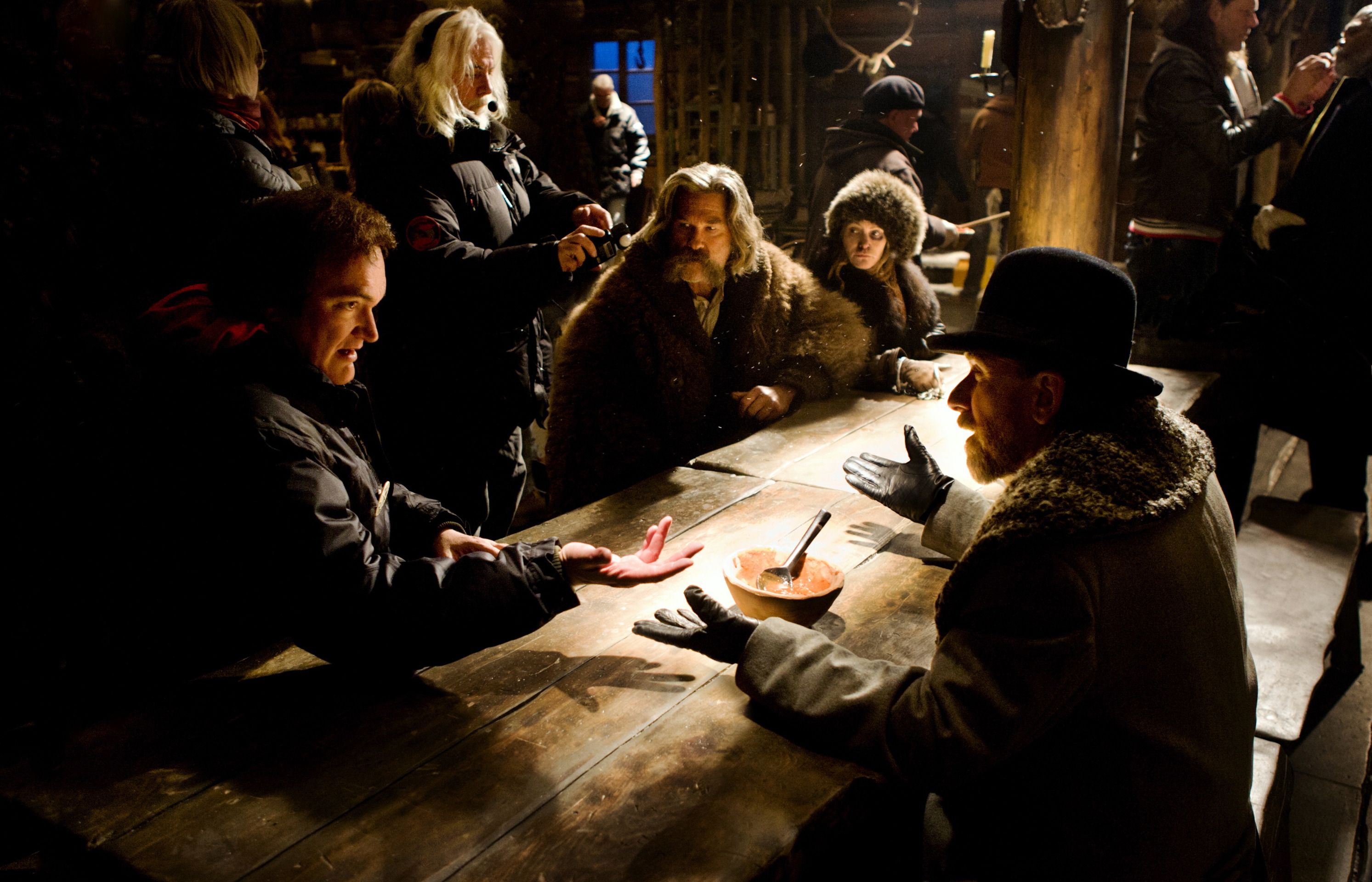
The film itself, for better or worse, plays as a three hour rendition of the bar scene from Inglorious Basterds. It's a restrained location with a lot of build-up that ends in bloodshed, the camera-work and performances are excellent and inventive, very rarely leaving the audience wanting. In the The Hateful Eight there is some fantastic use of smoke and shadow to create new prolific images of Western iconography (most specifically involved in the barn and in a moment that involves rather outdated male-to-male sexual-violence-panic), most involving Jackson's Warren. The score by The Maestro himself, Ennio Morricone, is downright amazing and the lighting, while unnatural to the point of reminding us of the theatrical roots of the script, is particularly good. The biggest gripe of the film is born out of the second half, where the film takes a swift change in approach, giving the audience extended flashbacks and narration by Tarantino himself. It feels as though the director was replaced in the making of this film in a manner that it clashes with the first half but the brief intermission beforehand minimises the damage. The same cannot be said for one extended flashback involving a cameo that while tense, feels a bit too self-indulgent and unnecessary, even for this director.
The Hateful Eight may not save film but it is an event worth shelling out top dollar for, provided you can stomach the length and self-indulgence of it all.


