Showing posts with label Alicia Vikander. Show all posts

Friday, 11 November 2016

The Light Between Oceans

Australian movies made for an international market never seem to hit the mark for the intended audience. Recent efforts like The Water Diviner and The Dressmaker were flops despite having big names like Russell Crowe and Kate Winslet. However, when you bring an outsider in to show their perspective on Australian life, it always seems a lot more effective. Add a couple of high profile international stars and you may have a winner.

Tom Sherbourne (Michael Fassbender) has returned home to Western Australia after World War I. In order to find some solitude after the horrors of war, he gets a job as a lighthouse keeper on an island of the coast. On one of his trips back to the mainland, he meets Isabel (Alicia Vikander) and slowly he falls in love with her, despite being separated by the sea. Eventually they wed and she moves to the island with him. Even though it is a harsh environment, they build a life together and are happy until Isabel miscarries not one but two pregnancies. All hope seems lost for them when a boat drifts ashore with a dead man and a baby girl. Isabel convinces Tom that they keep they child rather than telling anyone what happened and they soon return to life like nothing has happened. When they return to the mainland to show off their new child, Tom meets Hannah (Rachel Weisz), whom he learns lost her baby daughter and husband at sea a few years earlier. Soon Tom is wracked with grief and indecision about what to do.

Derek Cianfrance has always been an actor's director. His last two movies have been performance driven and The Light Between Oceans is no different. Michael Fassbender and Alicia Vikander are two actors at the top of their game. They, along with Rachel Weisz, all fall into stride with fantastic Aussie accents, one that isn't the easiest to do. Granted, that isn't what makes their performances good, it's just an added bonus. What makes their performances so great is their pure commitment to the emotions that are necessary. Tom is supposed to be a character haunted by his experiences in the war and Fassbender masterfully pulls that off. His guilt is entirely believable and at times you felt the pain he had in keeping his secret. Vikander and Weisz are also great at tearing the emotions out from the audience. Both women have their legitimate claim to raising their daughter but the pain in having to potentially give her up is too much. There are three great performances from Aussie veterans Bryan Brown, Jack Thompson and Gary MacDonald that really form a good backbone to the cast.


There are a few missteps in terms of telling the story however. Cianfrance is definitely a fan of an easily identifiable three act structure movie. First, Isabel and Tom get to know each other, then they get married and find the baby, finally the guilt and decision to tell the truth. This isn't necessarily a bad thing, but it makes the movie a tad slower and seems sloppy. There is a lot of clunky dialogue, like when Jack Thompson's character explains in a rather heavy handed way what happened to Hannah's husband, something the film has subtly hinted at using the unique cinema technique of editing. There is an early montage of letter writing between Tom and Isabel as well that is rather dull and expository.

I guess the reason I really like this movie because of the way it's an Australian film without being one. Australian movies tend to shoot themselves in the foot when it comes to international audiences because you can never beat Crocodile Dundee and that's what they want. It takes an outsider to show the rest of the world what an Aussie movie can be and it takes an actor like Fassbender to show that people really can do our accent. Other than that, it's an emotionally raw epic that tugs at the heartstrings. Especially that epilogue scene.


Sunday, 31 July 2016

Jason Bourne

The last movie in this series The Bourne Legacy was considered to be a disappointment by some fans due to the fact that despite his name being in the title, the movie distinctly lacked everyone's favourite amnesiac super weapon. There's no such confusion with this movie however, as you can't name it Jason Bourne and not have Matt Damon front and centre. This return to the character we know and love is all well and good, but it still follows the exact same formula that we saw in the original three movies.

Jason Bourne (Damon) has finally recovered from his amnesia, but is trying to live a quiet life under the radar. He is forced out of hiding however, after his old ally Nicky Parsons (Julia Stiles) has hacked into the CIA database, taking files about all the black op programs that the Agency has run in the past and ones they will run in the future. A team is assembled to hunt for Parsons and, by association, Bourne and is led by Heather Lee (Alicia Vikander), a young agent working in the Cyber Ops Division. She is overseen by the new Agency head Robert Dewey (Tommy Lee Jones), who is keen to protect his new Iron Hand program, even if that means sending an assassin (Vincent Cassel) to kill indiscriminately.

This is the first film in the series in which Tony Gilroy has not been involved in the writing process, but unless you know what to look for, the story doesn't seem like it has changed much. It does take into account the new world in which we live and while Bourne isn't trying to expose anything, he does get caught up in a new program which involves tracking everyone's social media posts and looks at the argument of giving up privacy for security. This storyline does take a back seat and while it is interesting, there isn't a lot of time given to it.

The action is everything we've come to expect in a Paul Greengrass movie. Lots of short choppy hand to hand combat, something that Bourne is an expert with. However, some shots of the action felt a bit off. There is a scene where Bourne falls off a rooftop and is aided with some CGI. This feels really out of place in a movie series that is reliant on all the action being done for real. The car chase at the end of the movie went way over the top too, for the level of plausibility we've come to expect. While the movie does talk about emergent technologies that can help in the intelligence field, the ones they take for granted seem extremely advanced. It's not that easy to gain access to a Berlin CCTV system from all the way in the US, but this movie shows us that anything is possible if you tap at a keyboard.


The characters were interesting enough for me, but again they were following in the footsteps of the same characters we've seen before. Control room woman backed by shady older man in charge of ruthless agent who tries to stop Bourne. While Vikander and Jones played their parts well, it just seemed like a paint by numbers. I will say however that Vincent Cassel was a standout as the ruthless assassin, but only because he seems like he does that as a side job (that or the professional thief that he was in Ocean's Twelve). I will say that Riz Ahmed was a standout in this movie, not just because his character was new or topical, but because he was very believable as the tech company head that he was playing.

So, is Jason Bourne worth seeing? I know that I have just gone on and on about how it's the same movie we've seen before, but it's still very good. The action sequences are beautifully choreographed (yes, they can be even when the camera is bouncing around) and the spy stuff feels genuine enough. It's a great two hours to sit down and try to make sense of the story (it's not that confusing) as Bourne retraces yet more steps to discover more of his past.


Wednesday, 27 January 2016

The Danish Girl

Tom Hooper has had a great run in recent years with The Kings Speech and Les Misérables. Ridley Scott jokingly described his films as ‘high brow’ in a recent director’s roundtable, and Hooper’s latest film The Danish Girl certainly touches on subject-matter that requires finesse. 

Set in 1920’s Copenhagen, an artistic couple Gerda Wegener (Alicia Vikander) and Einar Wegener (Eddie Redmayne) are achieving different levels of success. Einar’s landscapes are well-appreciated but the same can’t be said for Gerda’s portraits. Gerda tries to change that with a portrait of a ballet dancer (one of their friends), but when the model is late to show, Gerda asks Einar to stand in. Posing in tights and ballet shoes, the couple uncover Einar’s female alter-ego, Lili but the situation becomes challenging when Einar finds that Lili is closer to his real self than he first imagined. 

The Danish Girl definitely has its issues. For one, if you know the basic story of Lili Elbe then you basically know the movie, although reading up on her afterwards, it’s clear there are some details that have been changed. It would also be unfair of me to pick on its lack of dramatic intrigue, as that’s more of an issue that keeps cropping up in the format of these straightforward biopics, nonetheless even for somebody going in blind, it’s very clear where the story is taking you. Although it strides its two hour run-time with ease, The Danish Girl also has some jarring pacing problems, particularly when Lili undergoes her various sex-reassignment surgeries and time skips around with a lack of clarity. It’s unlikely that you’ll get bored at any point but the timing issues do stand out like a sore-thumb. 

Where The Danish Girl does succeed is in building its characters. Hooper manages to pack in a lot whilst also covering a huge array of content, thanks to actors that make the most of their performances. Alicia Vikander is mostly great as Gerda, although doesn’t trump her performance in Ex Machina - not that that’s a fair comparison of characters - and at points she seems to only be drawing on binary emotional states of jealous anger and guilt-ridden sadness. Eddie Redmayne once again provides a chameleonic performance - perhaps even equal to his bout as Hawking - and through his transformation, justifies the use of a non-trans actor. Although I guess we’ll never really know how well a transgender actor could have handled the character. 

The construction of the film, from score, to cinematography, to editing is very similar to a lot of the ‘straightforward biopics’ we’ve seen in recent years such as The Theory of Everything and Imitation Game, which makes it difficult to set each one’s aesthetics apart from others. However The Danish Girl does construct interesting and varied examples of mise en-scène, particularly the Copenhagen exteriors. Like Carol, The Danish Girl forms its 1920s era with subtlety - not shoving objects, people and events into the story as a glorified timestamp - however certain elements like the at times drab colour palette and their empty apartments creates a gloomy atmosphere which doesn’t necessarily match the overall tone of the film.

The Danish Girl is well acted - especially by Redmayne once again - and packs a lot of story-telling into two hours, albeit with a sometimes staggered pace. The narrative is always interesting, but it’s never unanticipated, and you can’t shake the feeling that the film is big-noting itself as much more influential than it ultimately is.

Tuesday, 27 October 2015

Burnt


At That Other Movie Blog we have a special relationship with the food film. We don't know whether it's just the fact that they are always slightly weird or if it's because we love food porn. Director John Wells dives headlong into this genre, but unlike Chef's take on street food or The Hundred Foot Journey's exploration of a home cooked experience, Burnt takes into the high stakes kitchen of a high end restaurant.

Adam Jones (Bradley Cooper) is a chef looking to get back on top of his game. After shucking a million oysters in Louisiana, he journeys to London where he seeks out old friend Tony (Daniel Brühl), who is mâitre d' at a high end restaurant. Adam reveals to Tony that he has come back to get a third Michelin star, the highest honour a chef can attain. To do this he acquires his own dream team of chefs, including Michel (Omar Sy), David (Sam Keeley) and Helene (Sienna Miller).

I'm pretty sure that the food film is the 2010's equivalent of the 80's action movie because it has all the same beats one of them. Guy who was once on top has hit rock bottom and through a series of montages defeats the bad guys and comes out on top. In the case with Burnt, the bad guys are Adam's own demons who are getting in the way of him being able to achieve that third Michelin star. I'm not entirely convinced though that this is an interesting enough conflict for a film like this because it forces the other characters to just fade into exposition or motivation for the main character.

And the other characters do suffer. Daniel Brühl's Tony only serves to hint at the life that Adam used to live. Young up-and-coming chef David goes around and tells everyone what a god Adam used to be. Characters like Michel and Helene are both different motivations that drive Adam forward, but that's all they serve as. There was a real missed opportunity in making rival chef Reece (played by Matthew Rhys) a bigger part of the film. The same could be said of Adam's ex-girlfriend Anne Marie (Alicia Vikander), who appears in only two scenes just to make a little bit of unnecessary conflict.

I'm not sure if the London setting was a good choice, or why they didn't take advantage of it more. I understand that it is a city where the Michelin Guidebook holds a lot of weight, moreso than any US city, but at the same time not as much as other European cities, but Burnt doesn't really go out of its way to show that London is a culinarily interesting city. Yes, we do get shown a lot of the multicultural influence that immigrants have on the food culture, but these forays are all too brief, oftentimes being shown in the films many montages.

The performances are all fairly average, with no one really sticking out. Cooper's sociopathic performance doesn't really make him relatable apart from a heart touching scene where he makes a cake for Helene's daughter. Sienna Miller reunites with Cooper again after American Sniper and proves to me once again that they have no chemistry. Brühl can make any performance his own, but Tony feels too much like a weak background character. Omar Sy is very understated in this film and would probably give a better performance in a better film, which this is not.

I wouldn't say I disliked this film, but I also wouldn't say that I liked it either. It's definitely a movie that you have to go and eat at a restaurant after, even if it's Burger King, because the one thing I did learn from Burnt is that there's nothing wrong with a Whopper.


Saturday, 19 September 2015

Everest

I love a good disaster movie, and I absolutely loath a bad one so Baltasar Kormákur's Everest had a lot riding on it for me. Based on the events surrounding the 1996 Mount Everest disaster, the film's stellar cast, chilling story and international production promises a unique and visceral experience. As with all biographical films, if you don't know the story, don't read up on it before going in. Needless to say though, people are gonna die.

Rob Hall (Jason Clarke) is a professional mountaineer whose business, Adventure Consultants aims to get people to the summit of Mount Everest, the tallest mountain in the world, and back down again as safely as possible. It's the start of the 1996 season and Hall is leading an expedition of eight clients, including Texan doctor Beck Weathers (Josh Brolin), journalist Jon Krakauer (Michael Kelly) who's documenting the trip, and Doug Hansen (John Hawkes) a mailman who is on his second attempt to climb the mountain. Hall says goodbye to his pregnant wife Jan (Keira Knightley) and the expedition gets underway.

At base camp they meet up with Helen Wilton (Emily Watson) who is managing the Adventure Consultants' tent, and Caroline Mackenzie (Alicia Vikander), the expeditions doctor. Scott Fischer (Jake Gyllenhaal) is running another expedition and is technically a business rival of Hall's. However, since they both aim to summit on May 10, the two decide to team up the expeditions and work together to reach the summit. However, a string of delays and encroaching bad weather ensure that the expedition ends in disaster.

Everest's rocky beginning hints at a relationship-focused but cliche-driven plot. Conversely, its subtle ending is the perfect close to a relentless, spine-chilling, brilliant film. Full disclosure: I saw this one in 3D, which I'm normally not a big proponent for. Its often either too distracting or not effective. However, here it captures the immense scale of the deadly mountain, the depth of the black crevasses, the ant-sized humans tackling an impossible task. The mountain is the star of this movie, it "has the final word", it's the ultimate antagonist. Full credit to DoP Salvatore Totino (Frost/Nixon) and the effects teams on this film for capturing the sheer beauty of such a deadly place. Each sequence is gripping and utterly realistic. At no point could I not suspend my disbelief. The true success of this film is its focus on spectacle, its ability to create an atmosphere and put the audience right in the action. 

Everest divides its time between the seemingly successful training/ascent and the tragic descent. All the while developing its ensemble of characters as we watch on hopelessly. The minutiae of the ascent, little things that ultimately see the characters set up to fail, are presented in an almost documentary-like style. No blame is laid, no message pressed about the fragility of human ambition. Kormákur simply presents the events as they unfolded and we're taken along for one hell of a ride. It's amazing how littered with A-list actors this film is, many of whom get very little screen time. Strong character development is sadly limited to a couple of the key roles, and at times - especially when they're into the 'death zone' and totally rugged up - it's difficult to work out who's who and what their individual slice of the story arc is. 

Jake Gyllenhaal gives a small but lively performance, and Brolin is well-rounded as Beck. Hawkes's Doug Hansen is one of the more interesting and fleshed-out characters, an amateur climber with a quiet persona and a lot of heart. The absolute standout though has to be Jason Clarke in the lead. Clarke has always had a lot of misses for me, especially in his Hollywood roles, but returning to his native tongue (well, New Zealand is close enough to Australia) has certainly paid off, because this is his best performance to date. He portrays Hall as a gentle, kind-hearted man who puts the safety and concern of his clients above all else. He's so good that all you really want towards the end is for him to survive. 

The women however, are left with generally unfulfilling roles. Emily Watson is fantastic as usual, and you really feel for her as she tries to manage the disaster from the base camp, however most of her screen-time she's left trying to communicate to people through a radio. Alicia Vikander does what she can as the expedition's doctor but she too is unable to do much from the base camp. Robin Wright has an unbelievably small role as Beck's wife, similar to Keira Knightley, who can't pull off the greatest of New Zealand accents but is responsible for one half of the film's most heartbreaking conversation toward the end, so she should still get some credit. 

Whilst there are some great portrayals from a stellar cast in Everest, and I think a lot of reviewers are downplaying the character development, this is still a film that's driven by spectacle. Its slightly emotionally-detracted style avoids cliche whilst still doing justice to a thrilling story that captures the essence of the human condition and transports you to the frosty Himalayas. Everest leaves you with both the desire to endeavor to climb it and at the same time, the tragic gut-necessity to stay as far away as possible.

Tuesday, 18 August 2015

The Man From U.N.C.L.E.

The Man From U.N.C.L.E. is one of those popular 60s spy TV shows that is finally getting a film adaptation, although twenty years after it's most associated show, Mission: Impossible. And like that other series, UNCLE has taken a different turn from it's source material, but this time into the world of comedy. A job that lands in expert hands with director Guy Ritchie.

Napoleon Solo (Henry Cavill) is top spy with the CIA. He is given a routine task of retrieving Gabby Teller (Alicia Vikander) from East Berlin so that the CIA can ascertain information about her former Nazi father who has gone missing with the knowledge of new atomic technology. Hot on his heels however, is Illya Kuryakin (Armie Hammer), the KGB's top killing machine. The day after Solo completes his mission, both he and Kuryakin find out that their respective governments have teamed them up to go after a terrorist organisation headed up by Victoria Vinciguerra (Elizabeth Debicki), who plans to use Teller's technological knowledge to build her own nuclear weapon.

Ritchie definitely returns to his roots here. While the film is still an action movie, comedy reins supreme with plenty of laughs, not unlike those you would find in Snatch. But his action movie experience from Sherlock Holmes is definitely a bonus, as the film uses slick stunt driving and excellent fight scenes, that are still laced with comedic moments. My only quibble with these action sequences is that there are certain number of stylised CGI transitions used, especially in the driving scenes that took me out of it slightly.

Henry Cavill is at his most charming and suits this charismatic role perfectly. Napoleon Solo is part spy and part conman (same thing really) and that is a big bonus for his character. Armie Hammer looks like he's having fun playing a more serious character after his romp in The Lone Ranger. It is also refreshing to see Alicia Vikander in a lighter movie after watching her do so many dramatic roles. Hugh Grant has a really fun supporting role.

The Man From U.N.C.L.E. is a much lighter movie than what I had expected, but nevertheless a very good and enjoyable adventure with two fantastic leads. The cool 60s setting didn't hurt the film at all.

Monday, 18 May 2015

Ex Machina


In his directorial debut, writer Alex Garland mixes simple storytelling with high concepts such as artificial intelligence, sexuality and data retention to make a powerful beautiful film. The combination of beautiful images and insanely good acting and you make a definite impact with your first film.

Caleb (Domhnall Gleeson) is a programmer for a popular search engine known as Bluebook. One day Caleb wins a prize of going to stay with his elusive boss Nathan (Oscar Isaac) for a week. Once he gets there, Caleb discovers that his true purpose is to conduct a Turing test on Ava (Alicia Vikander), a female robot created by Nathan that will change artificial intelligence forever. It is when Caleb discovers that Nathan brought him there for darker reasons than he thought, Caleb starts to question what exactly is going on.

Garland's story is very slow-burning, but at the same time your attention is being held completely. The simple narrative of two men and a robot is engaging, as Ava plays Nathan and Caleb off of one another. Indeed the changing relationship and power balance the two men go through is a remarkable thing to watch. Caleb enters this world vulnerable, but once he thinks he learns everything there is to know, his perceived power in his relationship with Nathan is fundamentally changed.

The very topical subject of mass surveillance is being looked at here, as Ava's programming allows her to get her intelligence from looking at what everyone is searching for on the internet. This multiplies the idea of people looking at what we are doing in the digital world by having a single all knowing machine looking at our digital footprints. Garland also examines the idea of programmed sexuality in humans via a scene between Caleb and Nathan. They discuss the idea of sexuality being inherently programmed into humans, so it doesn't matter if you are hetero- or homosexual, this is something that you are born with. This arises when Caleb confronts Nathan and asks whether he programmed Ava to be attracted to Caleb.

This film looks incredible. Cinematographer Rob Hardy has crafted some exceptional shots both of interiors and exteriors. Everything from forests to mountaintops looks so enticing and clear, but it is Hardy's use of lighting and colour in Nathan's underground facility that truly standout. The colour scheme draws heavily from the RGB scale and the predominant colours in each location are red, green and blue. In scenes where the facility goes into lockdown, the interior is bathed in foreboding red light that mutes out every other colour. In certain pivotal scenes, Hardy also employs a fisheye lens to great effect. The bending of the image adds a certain surreal feeling to these scenes.

The three central performances in this film are just so superb, each feeding into the other to make this film entirely collaborative. Domhnall Gleeson's Caleb is just so naïve of the situation that he is in and thinks he has complete control the entire time, but should really be trusting no one. His confused looks throughout the film are completely warranted as the unique situation he is in would be a new one for anybody. Oscar Isaac makes his character deep and intriguing whilst, not giving away any of his inner feelings. I feel as though Nathan has a complex past but I am happy not knowing what it is at all. Alicia Vikander ties it all together with her nuanced performance of Ava. She moves fluidly, but there are still some subtle movements she makes that are not entirely human. Sonoya Mizuno adds a great supporting character as a mute robot.

All up Alex Garland's first feature is a massive success. It offers a look at the near future the same way Spike Jonze did with Her, one that is not entirely implausible. I think the take away message from this film is that there may already be robots living among us.


Thursday, 30 April 2015

Testament of Youth


Seldom do we see a war film that is told from a female perspective. Sure there are female characters in war films, but these always act as something that drives the hero's journey to survive. Testament of Youth, however, shows the female relationship with war, particularly of the First World War in a time that was completely different to the one we live in now. 

The movie is based on the memoir of the same name by Vera Brittain. Vera (Alicia Vikander) is a young woman living with her family in the English countryside. She dreams of going to Oxford to study and finally gets in at the outset of the war. Prior to this, she has started a relationship with one of her brother's schoolmates, Roland Leighton (Kit Harrington). This relationship is tested when Roland and her brother Edward (Taron Egerton) volunteer to the army and are eventually sent to the front.

The film does capture some of the issues that plagued women's rights at the turn of the century. Vera has to deal with issues like not being expected to get a higher education (or any education), expectations of staying at home and doing womanly chores, not at all volunteering for any form of service and, this was the most horrifying idea to men of the time, having the right to vote. Apart from female suffrage, which came a little later in the history of the twentieth century, I feel the film tackles all these issues in a rather succinct way. Toward the middle of the film, Vera volunteers to become a nurse and is not only looked down upon by her family, but also the nurses who think that this kind of work is below someone of her social standing. The film also tells of a heart-wrenching romance between Vera and Roland.

This film is a technical masterpiece. The shots are so incredibly crafted, with each one being carefully placed and framed. The camera also moves in not only fluid motions, but some movements are striking for the way they get the viewer to focus on a particular piece of action. The editing is also a marvel and is probably one of the most well edited films I've ever seen. The film occasionally cuts back to shots that we have seen before, most often when Vera is remembering time spent with Roland, and these are done in such a way that they are the reverse shots of what is happening in the current scene. It is a very clever way to do flashbacks and I applaud editor Lucia Zucchetti for this amazing style.

The acting also blew me away, considering I didn't have the highest of hopes for the two leads. Alicia Vikander is beginning to grow on me, despite a rather average performance in last year's Aussie crime flick Son of a Gun. She gives Vera a strong determination that makes you want to succeed in her life, but she also is able to convey the scenes with heartbreak in an amazing manner. Kit Harington is a lot better here than that brooding sad Jon Snow he is always playing. Supporting roles from Colin Morgan, Taron Egerton, Emily Watson and Dominic West are all fantastic, although I did want to see a fair bit more of West.

Testament of Youth is a heart breaking film that is very bleak, but it is also a fantastic film. Despite my feeling that the runtime was maybe ten minutes too long, you are sure to get swept along in the engaging, well written adaptation.


Monday, 9 March 2015

Seventh Son


                                               "To be no-good at a bad thing is good."


A wise and battle-weary Old Man is confronted by the greatest enemy from his past and recruits a young farm-Boy who slowly learns his destiny through interaction with a mysterious artifact he owns. As the boy grows, the Man, though grumpy, comes to respect and rely on the Boy, the Boy in turn slowly learns to accept the teachings of the Old Man and together the boy falls in love and they defeat the Evil and its Empire.

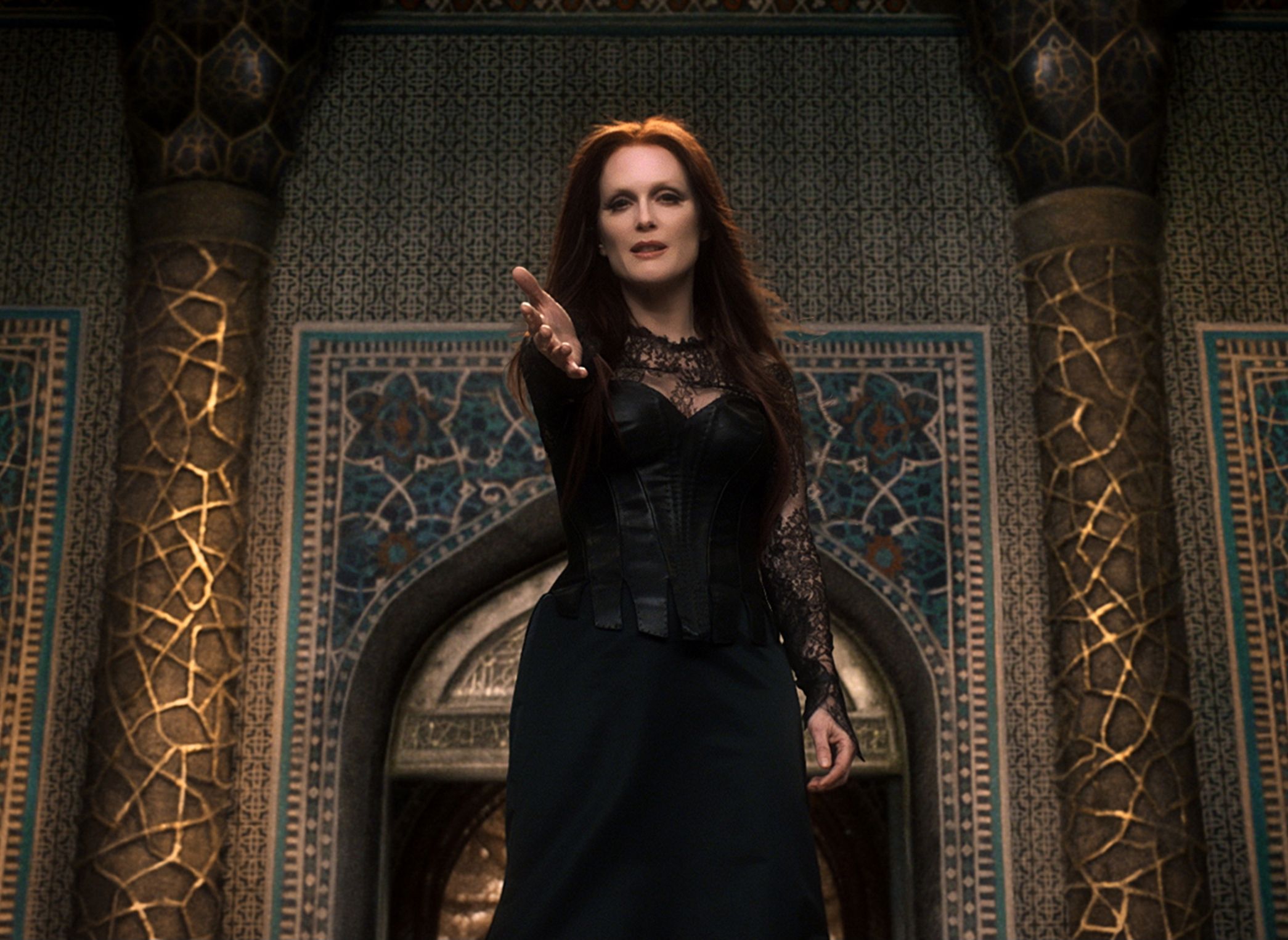
That's pretty much the basic plot outline of nearly every fantasy film made since Star Wars at the very least, whether it's Science Fantasy like Star Wars (or as TV Tropes dubs it, the Standard Sci-fi Setting), or the Standard Fantasy Setting from a popular book (see: Eragon). The latest incarnation of this tired trope is helmed by Russian director Sergei Bodrov, director and writer of QuickiePrisoner of the Mountains, and Mongol: The Rise of Genghis Khan. Based on Joseph Delaney's 2004 fantasy novel, The Spook's ApprenticeSeventh Son follows Tom Ward, the seventh son of a seventh son as Jeff Bridges' Master Gregory, a Spook (basically a Monster Hunter Gandalf), recruits him to defeat the recently escaped evil witch Mother Malkin, played by Julianne Moore, who should know better.

Seventh Son is an awful, boring and completely unoriginal film in almost every way. The source material is apparently loosely based on Lancashire, the English county Delaney is from, and yet the film is shot in the lush wilderness of British Columbia, a Canadian province. Other sets range from Christian churchs to Meditteranean market-harbour-cities, and finally to an ancient Roman-themed deserted mountain fortress with Arabic interior decorations. The deluge of influences on the production design becomes so distracting that the first time you see Asian peasants carrying water buckets in the background you're confused, but by the time the Hindu protector god Vishnu appears alongside a giant salamander and a pair of dragons to destroy the harbour-city one no longer cares about a consistent universe. In terms of costuming it cannot be stressed enough how obviously this film wants the viewer to sub-consciously align it with Star Wars with the fact that Tom, Gregory and in one dream sequence Tom's mother all dress like fucking Jedi. It's more confusing than Lando Calrissian wearing Han Solo's outfit at the end of Empire Strikes Back.


Ironically, there's little to no magic used besides constant transformations into bear, dragon or salamander by villains, and besides those creatures and some worthless ghosts that are somewhere between a Dementor and the ghost army from Return of the King, there are no creatures or monsters in this magical world. Tom and Gregory's repertoire of magical ability is as extensive and interesting as their names are exotic as their main solutions to magical shape-shifter attack is throw glitter, light torch or swing sword.

On the performances, Ben Barnes is as handsome as a young David Wenham look-alike should be, but otherwise predictably bland white-bread protagonist. He offers no charm, no personality, and his character goes from gormless farmboy to trained warrior apparently by plot magic. His lineage that is the reason for his selection and the film's title is inconsequential, his father appears in one scene (you'd be mistaken for thinking the father of the seventh son would matter, but no), and any power he has comes from a magic amulet the audience is told his mother gave him that is ignored before the third act. His love interest is so worthless she only warrants mentioning for her AWFUL lines, but the actress' name is Alicia Vikander. Jeff Bridges must have been on another planet making this film, probably the one from Zardoz as he's doing a Sean Connery impersonation via his Rooster Cogburn character from True Grit. His constant goofy expressions and gruff demeanour only inflame the burning apathy in the hearts of the audience. Julianne Moore is utterly wasted in this role but is the one enjoyable aspect of it because she's Julianne Moore.


Seventh Son is a waste of time and money. That is the worst thing that I can possibly say about a film, that it is worth ignoring. There's no magic, no mystery, no personality and no care for this project. The amount of talent wasted on this project (Moore, Bridges, and writer Steven Knight) is damn near a criminal act, and if there's any film worth forgetting about this year, it's Seventh Son.


Friday, 10 October 2014

Son Of A Gun

I don't know how a hero of a movie could be so dumb. Like really dumb. But then again if he wasn't so dumb, the events that cause main plot of this movie wouldn't have happened. Julius Avery's crime thriller is certainly a ride for the audience, but at moments I feel like he dropped the ball.

JR (Brendan Thwaites) is a young crook who is adjusting to his first stint in prison. Eager to prove he is not a weakling, he gets in fights with other inmates and this brings him to the attention of Brendan (Ewan McGregor), a fierce armed robber. Brendan takes JR under his wing and once JR is out of prison, Brendan gets him to do various jobs for him.

The plot of this movie is a little all over the place. Instead of just sticking to one particular part of the criminal life, the movie jumps from a movie about prison life, mobsters and heists. While many of these sequences work well as their own small plots, smashing them together to form a larger narrative doesn't really work. The themes of this movie are also a little too obvious. Throughout the film, games of chess are played by characters who want to prove how smart they are. But the film also labours the point that each character represents a type of chess piece.

The character of JR is intriguing at times, we never learn why he was in prison and his background is hinted at, but never fleshed out. From that we are left to fill in the blanks and give our own theories as to who he actually is. One thing we do know is that he is an idiot and I think he is told this by nearly every character in the film. Thwaites plays him well, although whether he is meant to be a likeable character is a mystery to me.

Unlike the idiot that is JR, McGregor plays the character of Brendan with sharp wit. Brendan can see what is happening around him and the consequences of other's actions with a lot of foresight. McGregor also brings a lot of charm to this violent character, but unlike the other characters, his back story is glaringly lacking.

The character of Tasha (Alicia Vikander) is a bit of a missed opportunity. She only really serves to be a love interest to JR. She hints at a violent and turbulent past in coming to Australia but that is picked up and then dropped almost immediately. She is an Eastern European girl who is bought to Australia with the promise of a passport after she gets a student visa, but ultimately ends up working in a strip club. This was a perfect opportunity to explore the scary and sadly real world of sex trafficking, but it wasn't to be.

The supporting characters only serve to move the plot along and once they have served that purpose, they are unceremoniously dumped. Brendan's partner Sterlo (Matt Nable) is a fun character to watch, but he is killed off soon after he is no longer needed. Also the primary antagonist, Sam (Jacek Koman), is used so negligibly that I didn't know his name for the first half of the movie. Damon Herriman makes a brief cameo as a crazy gun runner in a scene that was a fun break in the tension.

The film's action sequences are rather spectacular. The driving chase scene that takes place is a stand-out sequence, with tense moments and amazing crashes. To see something like that in an independent Australian film is great to see.

Verdict: Despite having some plot problems and the main character being a complete idiot, Son Of A Gun manages to tell an intriguing and fun crime movie.


Jasper Roberts Consulting - Widget