Showing posts with label Julianne Moore. Show all posts

Friday, 20 November 2015

The Hunger Games: Mockingjay - Part 2

The Hunger Games is one of those series that I never really give any thought towards until the next film comes around, and apparently it’s been a year since Mockingjay - Part 1. Francis Lawrence - who has directed all but the first of the films – has returned to wrap-up the young-adult series with Mockingjay - Part 2

The nation of Panem is now in the midst of a civil war, with the rebels led by President Coin (Julianne Moore) looking to assassinate President Snow (Donald Sutherland) and unify the districts. Katniss (Jennifer Lawrence) is recovering from the injuries that Peeta (Josh Hutcherson) has caused her and their relationship is in turmoil as he becomes more and more unstable. The time has come to take down President Snow, with the rebels planning to film Katniss assassinating him as the ultimate piece of propaganda. 

Traversing through the Capitol to reach the palace is a challenge. Snow has evacuated the perimeter and transformed it into a sadistic minefield of unique ways to die. Katniss and the District 13 unit undertake the challenging mission with her friends Gale (Liam Hemsworth), Finnick (Sam Claflin) and Cressida (Natalie Dormer), who is to direct the propaganda piece. This is their best chance to take down Snow’s regime, but it’s certainly no easy task. 

There are some interesting side-stories in Part 2 that jazz up the arcs of the various characters - such as Peeta’s inability to control himself at points due to the Capitol's brainwashing, and Finnick’s marriage which gives his character more of a reason to fight for Panem’s freedom - and this is essentially still an ensemble film, however the ‘will they, won’t they, and with whom?’ love triangle between, Katniss, Peeta and Gale is beginning to wear extremely thin, and is resolved in both an expected and confusing way. The same can be said for most of the film, it reaches the point that you knew it would, but in a convoluted and stretched-out manner. Most of the film feels like a montage and is at times, difficult to follow. They could have had about five end-points before they finally finish with such an overly-sentimental, unnecessary scene that it actually detracts from the quality of the film. It’s as if the producers were desperately trying to hold on to the only half-decent Young Adult film series they have. 

On top of this there are plot-holes and timing issues that quite noticeably screw with the sense of immersion. For example at the beginning of the film, following on from the injuries she sustained at the end of the last, Katniss is almost completely unable to speak. However, no more than five minutes later, she’s up and having a healthy conversation with President Coin and Plutarch - the last filmic appearance of the late Philip Seymour Hoffman and a reminder that this movie was (largely) filmed years ago, at the same time as Part 1. Perhaps that’s why it feels so rushed. It’s uncertain how much time is passing throughout Mockingjay - Part 2, and that removes much of the tension that it works so needlessly to build up. 


To redeem itself from some of these issues, Mockingjay - Part 2 does have some pretty intense fight sequences, including a weird hot-oil chase and a sewer-system scene which is either a homage or a shameless rip-off of Aliens, depending on how you view it. The concept of President Snow evacuating the outskirts of the Capitol and filling the streets with a system of eloquent booby-traps is a pretty cool idea, but it does feel a bit-too much like it’s YA competitor The Maze Runner - perhaps it’s a big F-You from the author, Suzanne Collins to Maze Runner’s James Dashner. 

Past issues with the characters again crop-up again here, with Natalie Dormer’s Cressida as annoying as ever, Woody Harrelson barely making an appearance, and Moore’s President Coin a bland mirror of Snow, preaching a distorted view of what ultimately becomes the same ideology. President Snow is still pretty much the only likable character for me, with his eccentric bond-villian persona the guilty pleasure of the series, played expertly by the great Donald Sutherland. Although I must say Katniss is suitably badass for such a finale. Ultimately though I care about as much for the characters as I do for the world that they inhabit. 

For an impartial-viewer, The Hunger Games: Mockingjay Part 2 is a relatively satisfying, albeit overly long and convoluted conclusion to a series that’s never particularly gelled with me. It has its issues but keeps your attention fairly well. If you’re a massive fan, I can’t speak for how much you’ll enjoy it, but it’s certainly worth a watch even if only to serve as a catharsis for the many hours you’ve already spent delving into this series.

Saturday, 23 May 2015

Classic Movie Review: The Lost World: Jurassic Park (1997)

The Lost World: Jurassic Park is the second instalment and at the time of its release it was seen as a very poor sequel to the original film. And while it does live up to comparisons with the original film, it is a very fun movie in its own right and has a cast of great characters and all new dinosaurs to hold up even eighteen years later.

Set roughly four years after the events of the first film, Dr Ian Malcolm (Jeff Goldblum) is summoned to the home of John Hammond (Richard Attenborough) where he is asked to lead a team of experts to the second island that contains dinosaurs in Costa Rica. However when Malcolm discovers that his girlfriend, palaeontologist Sarah Harding (Julianne Moore) has been sent in advance, the team leaves a little early. However, once the team gets to the island, they discover two things; Malcolm's daughter Kelly (Vanessa Lee Chester) has stowed away in one of the trucks, and that a team of InGen scientists led by Hammond's nephew Peter Ludlow (Arliss Howard), the current InGen CEO has led a team to the island to extract a number of dinosaurs for a theme park in San Diego.

The Lost World takes no time in getting to the action. This movie relies on none of the suspense in getting to the dinosaurs that the first film did and as a result we can get a lot more fun. Within thirty minutes we are in the middle of a chase of the InGen team and a whole herd of dinosaurs. From this point on it is all action, right up to the thrilling climax which involves a T-Rex rampaging through the streets of San Diego. While this sequence may seem out of place to some, it is a perfect place to show off how big dinosaurs were in comparison to our modern buildings.


This movie has some pretty cheesy, but memorable quotes that are delivered quite well by Jeff Goldblum. The line "Where you're going is the only place on Earth where the geese chase you" is but one of the many wonderful lines. The character of Dr. Burke has some absurd long explanations about different dinosaurs that are fun to sit through as they are quite complex and scientific, but are one of the details that make this film well rounded, but at the same time it isn't taking itself too seriously. The film also has a surprising amount of characterisation for a film of this budget and genre. The leader of InGen's safari team Roland Tembo (Pete Postlethwaite) is a well built character and his relationship with others, especially his second-in-command Dieter (Peter Stormare), is something to write about.

The movie introduces some new dinosaurs into the mix. Every kid's favourite spiky tailed herbivore Stegosaurus gets a lengthy action sequence early on, as well as a new small dino called a Compy that terrified me when I was a kid. The Velociraptors also play a much bigger part in the film and their intelligence is fleshed out a little more (although not to same extent as in the third film. The CGI dinosaur design had developed a lot further than what they were at the first time and as a result the dinosaurs are a lot more mobile. Spielberg however still uses a lot of animatronics that work seamlessly with the CGI and is something that you won't find in movies made today.

Jeff Goldblum really does steal the show in this movie. He is well practiced with his character of Ian Malcolm and his own idiosyncrasies just add to his character. Julianne Moore is superb and was having a couple of good years around this time with both Boogie Nights (1997) and The Big Lebowski (1998). Arliss Howard (of Full Metal Jacket fame) is great as the greedy villain Ludlow. My only criticism is that Vince Vaughn should have stuck around for longer as he disappears two-thirds of the way into the film. Keep an eye out early on for a twenty-five year old Eli Roth playing Subway Man (you'll know the character when you see him).

While this is far from being Steven Spielberg's magnum opus (I think he's still searching for that himself), it is an amazing film to re-watch and rediscover as a fun part of the Jurassic Park series. I know for a fact that I enjoy it time after time.


Monday, 9 March 2015

Seventh Son


                                               "To be no-good at a bad thing is good."


A wise and battle-weary Old Man is confronted by the greatest enemy from his past and recruits a young farm-Boy who slowly learns his destiny through interaction with a mysterious artifact he owns. As the boy grows, the Man, though grumpy, comes to respect and rely on the Boy, the Boy in turn slowly learns to accept the teachings of the Old Man and together the boy falls in love and they defeat the Evil and its Empire.

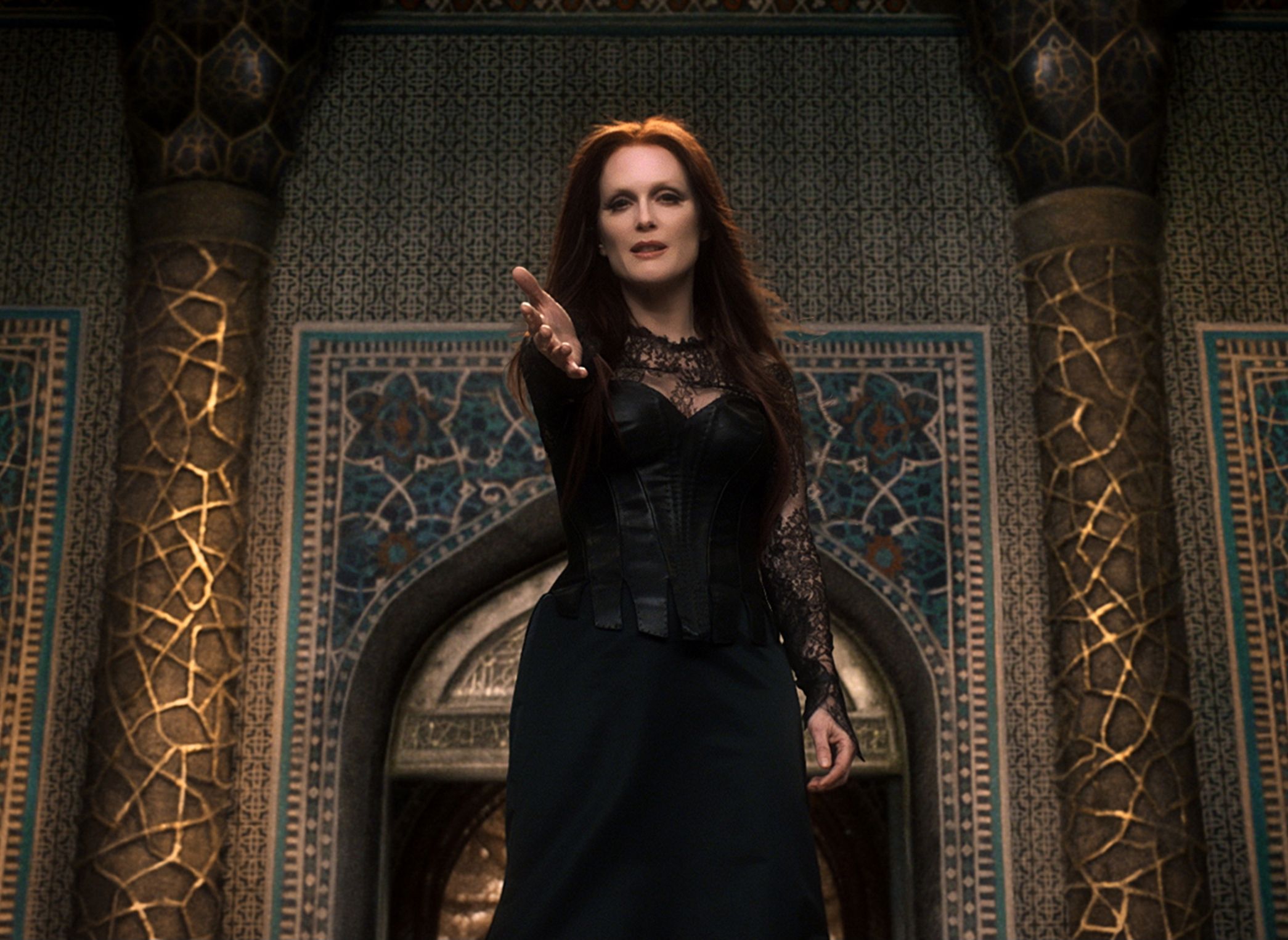
That's pretty much the basic plot outline of nearly every fantasy film made since Star Wars at the very least, whether it's Science Fantasy like Star Wars (or as TV Tropes dubs it, the Standard Sci-fi Setting), or the Standard Fantasy Setting from a popular book (see: Eragon). The latest incarnation of this tired trope is helmed by Russian director Sergei Bodrov, director and writer of QuickiePrisoner of the Mountains, and Mongol: The Rise of Genghis Khan. Based on Joseph Delaney's 2004 fantasy novel, The Spook's ApprenticeSeventh Son follows Tom Ward, the seventh son of a seventh son as Jeff Bridges' Master Gregory, a Spook (basically a Monster Hunter Gandalf), recruits him to defeat the recently escaped evil witch Mother Malkin, played by Julianne Moore, who should know better.

Seventh Son is an awful, boring and completely unoriginal film in almost every way. The source material is apparently loosely based on Lancashire, the English county Delaney is from, and yet the film is shot in the lush wilderness of British Columbia, a Canadian province. Other sets range from Christian churchs to Meditteranean market-harbour-cities, and finally to an ancient Roman-themed deserted mountain fortress with Arabic interior decorations. The deluge of influences on the production design becomes so distracting that the first time you see Asian peasants carrying water buckets in the background you're confused, but by the time the Hindu protector god Vishnu appears alongside a giant salamander and a pair of dragons to destroy the harbour-city one no longer cares about a consistent universe. In terms of costuming it cannot be stressed enough how obviously this film wants the viewer to sub-consciously align it with Star Wars with the fact that Tom, Gregory and in one dream sequence Tom's mother all dress like fucking Jedi. It's more confusing than Lando Calrissian wearing Han Solo's outfit at the end of Empire Strikes Back.


Ironically, there's little to no magic used besides constant transformations into bear, dragon or salamander by villains, and besides those creatures and some worthless ghosts that are somewhere between a Dementor and the ghost army from Return of the King, there are no creatures or monsters in this magical world. Tom and Gregory's repertoire of magical ability is as extensive and interesting as their names are exotic as their main solutions to magical shape-shifter attack is throw glitter, light torch or swing sword.

On the performances, Ben Barnes is as handsome as a young David Wenham look-alike should be, but otherwise predictably bland white-bread protagonist. He offers no charm, no personality, and his character goes from gormless farmboy to trained warrior apparently by plot magic. His lineage that is the reason for his selection and the film's title is inconsequential, his father appears in one scene (you'd be mistaken for thinking the father of the seventh son would matter, but no), and any power he has comes from a magic amulet the audience is told his mother gave him that is ignored before the third act. His love interest is so worthless she only warrants mentioning for her AWFUL lines, but the actress' name is Alicia Vikander. Jeff Bridges must have been on another planet making this film, probably the one from Zardoz as he's doing a Sean Connery impersonation via his Rooster Cogburn character from True Grit. His constant goofy expressions and gruff demeanour only inflame the burning apathy in the hearts of the audience. Julianne Moore is utterly wasted in this role but is the one enjoyable aspect of it because she's Julianne Moore.


Seventh Son is a waste of time and money. That is the worst thing that I can possibly say about a film, that it is worth ignoring. There's no magic, no mystery, no personality and no care for this project. The amount of talent wasted on this project (Moore, Bridges, and writer Steven Knight) is damn near a criminal act, and if there's any film worth forgetting about this year, it's Seventh Son.


Wednesday, 4 February 2015

Still Alice

Still Alice is a modern drama focused on Alice Howland (Julianne Moore), a renowned and successful linguistics professor. She lives comfortably in New York with her scientist husband John (Alec Baldwin), though she is often visited by her three grown children, Anna (Kate Bosworth), Tom (Hunter Parrish), and Lydia (Kristen Stewart) who resides in LA. Shortly after her 50th birthday Alice is startled as she begins to gradually lose words and other important details from her life, prompting her to visit a neurologist. She is soon diagnosed with early on-set Alzheimer's and begins to lose her ability to communicate and be herself as her family watches on.

Directors Wash Westmoreland and Richard Glatzer are clearly comfortable with their partnership as Still Alice is their fifth collaboration, and certainly their largest. There are three main filming styles that govern the film and govern it well. There is the keenly framed, tripod-mounted shooting style that dominates the film as it is representative of the lucid Alice and the world of those around her. In direct and simple contrast is the hand-held and/or focus-heavy shooting of the afflicted Alice. Here, Alice is often shot in close or medium with the world around her being heavily blurred, and often she will only enter frame after a momentary delay, as though she is a stranger. The final style is reserved for flashbacks to her childhood, and these appear to be (as far as I am aware) shot on Super 8mm. These are grainy and vibrantly coloured moments that stand out distinctively from the rest of the film. The score is often centred around a piano and its cautiously slow tones too often feel like the blank spots of Alice's mental state.

In many ways Still Alice is not at all surprising to those with even the most cursory knowledge of either Alzheimer's or Julianne Moore's acting ability, but the extent of both of these is. Alzheimer's is notoriously devastating and Moore famously talented, but the totality of both of these realities is confronting. At first Alice carries herself with the signature confidence, self-awareness and casual poise that's indicative of the inspired decision to cast Julianne Moore, but as her disease takes hold and tightens its grip on her, Alice becomes more (or perhaps less) than forgetful. Her posture slackens, her articulation suffers and so does her ability to focus, as stated earlier Moore's totality in this character's situation is moving and talented. Moore's performance, and the film by extension, treat Alzheimer's without reverence, hate or kid gloves. As Alice herself states in a captivating speech at the end of the second act, "I am not suffering, I am struggling." The supporting cast consisting primarily of Baldwin, Stewart and Parrish as Alice's family struggle alongside. Baldwin especially impresses quietly with his devastation and helplessness apparent in the bevy of short glances he gives Alice's way as she forgets to be who she is. In many ways the woman he loves is dying before his eyes and Baldwin's reaction as John are simply crushing. Within Alice's family there are brimming grievances, but overall no great dramas and barely a classic dinnertime feud, though perhaps because the narrative is so focused on Alice these would become intrusive. Either way, the film's steadfast perspective of Alice is more than enough.

Still Alice doesn't have a clear ending, but rather the closing titles appear and close the audience's perspective on her life, mirroring the effect of the disease. This is a film carried on Moore's capable shoulders, that appropriately and maturely examines a complex familial scenario. Absolutely a must for those in the mood to learn and cry.


Thursday, 20 November 2014

The Hunger Games: Mockingjay - Part 1

I've never been much of a fan of the Hunger Games series, or indeed any of the many teenage dystopic films, apart from perhaps The Maze Runner. So walking into the latest instalment, Mockingjay - Part 1 I was a bit hesitant. So, does Part 1 continue in the Battle Royale-esque manner of the first two?

After Katniss (Jennifer Lawrence) destroys the arena, Plutarch (Philip Seymour Hoffman) takes her to District 13, an underground embattlement where she meets President Coin (Julianne Moore). Coin persuades Katniss to become their Mockingjay, a symbol of revolution that will boost the uproar against the Capitol. They design a series of propaganda videos to spread the word, but Haymitch (Woody Harrelson) quite rightly suggests that she needs to send her message from the battlefield for it to have influence.

Armed with a film crew, directed by Cressida (Natalie Dormer), Katinss visits a district that has just survived a vicious bombing raid by the Captiol, to see if she can capture both the atrocities of the Capitol, and the spirit of the survivors, in the hope of fanning the flames of revolution. Whilst at the same time, she remains concerned about the state of Peeta (Josh Hutcherson) and his existence within the Capitol.

With Francis Lawrence (I Am Legend, Water for Elephants) reprising directorial control after the success of Catching Fire, the film takes a while to gain momentum, only really finding its stride by the second half. The story of Mockingjay seems much more focused on the political manoeuvres occurring in this Orwellian society and is clearly building up for Part 2, the final instalment in the series. Nevertheless, I was far more absorbed here than I was in the previous two films and for the first real time in the series, I'm actually interested in where it's going. I just wish the first half of this film was as good as the second.

I've never been able to understand how The Hunger Games gets such a vast array of superb actors on-board (Spoiler Alert: It's probably money) and generally they all provide decent if (certainly) not career-peaking performances. Jennifer Lawrence maintains the strong yet troubled nature of Katniss, with both Liam Hemsworth and Hutcherson supporting her well. The late Philip Seymour Hoffman is gentle and sympathetic as Plutarch and Woody Harrelson as Haymitch is still the lovable jackass that he was in the first instalments. Although Julianne Moore is less than stellar, mainly because President Coin is such a bland character, and Natalie Dormer seems to play the same smirking egotist that she does in most her roles, although I suppose it works quite well when playing a director.

Whilst for the first half, Part 1 fails to move away from the stock-standard 1984 dystopia that we've seen many times before, it flourishes more as it moves on, supported by a great cast and a handful of action scenes for good measure.


Jasper Roberts Consulting - Widget