Showing posts with label Samuel L. Jackson. Show all posts

Saturday, 21 January 2017

xXx: The Return of Xander Cage

After leaving this movie, my seventeen year old cousin told me that he had lost all respect for Vin Diesel. That got me thinking. The Iron Giant came out before he was born, Pitch Black came out the year he was born and The Fast and the Furious didn't come out much later after that (side note: that first F&F movie is the only one I like because my school camp didn't have any other movies to show us). So why did my cousin have any respect for him in the first place? Maybe Groot, I guess. Hopefully you can tell from this opening paragraph that I don't have much to say about this movie, so it's going to be a fun review for all of us.

Former government operative and extreme sport enthusiast Xander Cage (Vin Diesel) is coaxed out of retirement in order to hunt down a terrorist named Xiang (Donnie Yen) who has stolen a device that can bring satellites crashing down to the Earth. But shock horror, Xiang is actually part of the same xXx program and Xander's boss Jane Marke (Toni Collette) is the bad guy. There you go, you've just been informed of the world's most basic and predictable action movie ever. Helping Xander is the most standard group of buddies ever. Standard except for one DJ who he keeps around for the good times.

The action in this movie is the most logical thing happening. That's weird to say considering the movie starts with Diesel skiing down a gravelly hill in move that makes me question whether they understand how skis or gravel works. But then again this is the movie that has dirt bikes that whip down rivers and under waves (all in the same chase mind you). Because this is a movie that is appealing only to teenage boys, there are a lot of gratuitous girls in bikini shots, as well as a scene in which Diesel is the 'victim' of a female gangbang (I actually feel disgusted that I wrote that sentence, let alone watched it in a movie). The movie tries to even out this disgrace by adding two female action heroes, which doesn't work. Before you all go "Ruby Rose is my kween, she slays in OITNB, what are you talking about?", I have to remind you that I grew up with her being presenter on the Australian version of MTV and nothing will ever get that out of my head. In addition to all this weird portrayal of women where they're not sure if they should degrade them or make them strong, Nina Dobrev plays the cringiest character ever, someone who is geeky and shy, but unafraid of telling Xander Cage she likes rough sex and flirting with Ruby Rose. Again, this is obviously the very warped fantasy of what a woman should be like.

The moment well-respected martial artist Donnie Yen realised he needs a new agent

This movie does give me a chance to educate you a little about the industry though; namely the relationship between Hollywood and China. This year it is expected that Chinese ticket sales will surpass those of America for the first time in history. Because of this, Hollywood studios want to capitalise on that untapped market by getting their movies shown in China. Now the Chinese government only lets in a limited number of decadent Western films a year (and boy is this one decadent) and to make those chances higher, a studio can co-produce with a Chinese company. In order to do that, the filmmakers have to agree to fill a certain number of lead roles with Chinese actors. (I know that this is a deeply complex issue and I'd suggest checking out this video by Vox). What does all this have to do with our horrible movie. Well, it explains the inclusion of Chinese actors Tony Jaa, Donnie Yen and Kris Wu and also why this movie will probably do so well in that market.

xXx is an extremely subpar action movie. I know that sometimes I come of as someone who doesn't respect the genre, but I do enjoy it and know when something is trying. There was no effort whatsoever here. Gone are the extreme sports that I'm guessing the x's stand for and are replaced by a lot of standing around with arms spread wide open. And remember those character title cards that everyone thought were pointless in Suicide Squad, get ready for a lot of those.


Sunday, 2 October 2016

Miss Peregrine's Home for Peculiar Children


I’m torn between starting this off with ‘Films like this remind us all of why it is we loved Tim Burton’s early work so much’ and ‘Seriously, is Samuel L. Jackson in every film nowadays?!’ Both? Both. Both is good.

In modern day Florida, awkward teenager Jake (Asa Butterfield) struggles to fit in with his peers and attempts to get through everyday life. With a mother and father more concerned with their respective lives than the welfare and happiness of their son, his father figure is presented in the form of his Grandfather Abe, who encouraged his sense of adventure and told Jake tales of his triumphs in the war fighting ‘monsters’. After Abe dies under mysterious circumstances, Jake is encouraged to visit a small island off the coast of Wales with his father in order to find closure in the children’s home Abe was sent to as a child. However, what he finds creates more questions than it does answers as he encounters Miss Peregrine and attempts to come to grips with his Grandfather’s past. Jake is suddenly thrust into a world where the threat against the ones he loves is one only he can stop.

The positives: This film has a lot going for it. A strong cast including Asa Butterfield, Samuel L. Jackson, Chris O’Dowd (good to see him branching out!) and Dame Judi Dench allow for the acting to be consistent and entertaining. Eva Green’s portrayal of the falcon herself was also a stand out, but at times felt a little overdone. All of the acting from the children was also surprisingly good. Shout out to Cameron King who was invisible for the whole film and yet still managed to be one of the most charismatic and funny characters. I am pleased to say that for once I don’t have to critique the pacing of the film: it used its time wisely, fleshed out characters and didn’t rush through important plot points for the sake of cramming in more action. As well as this, Burton’s signature style is clearly evident here: there are a variety of scary and disturbing elements that only serve to make the film not only more entertaining, but uniquely Burton. The cinematography and shot symmetry are beautiful and you can’t help but admire the use of colour, set and costume design: they all bear the Burton trademark and they really help to set this film apart from some of his other more recent work, creating a stunning world audiences will love stepping into. 

The negatives: For those of you who are looking for a book accurate adaptation (that is the original book of the same title by Ransom Riggs which went number 1 a whole bunch of times, seriously its excellent and I recommend giving it a read), this isn’t it. Anyone who has read the book and seen the trailer will already have noticed that Olive’s and Emma’s powers have been switched, and the film focuses a lot more on making it relevant in today’s modern world meaning that it has a few plot holes that would have been solved by the book’s plot. Its difficult to pin down, but there tends to be a hollowness to the film that can make it difficult to engage with, almost as if too much effort was point into its looks rather than the importance of underlying substance. As well as this, the film is mostly what you see is what you get: if you’ve seen the trailers and TV spots and have decided its not for you, seeing it isn’t going to change your mind. Still, that doesn’t necessarily negate the film, its’ certainly a good time, but that may leave some fans disappointed.

All in all, Miss Peregrines Annoyingly Long Title to Type Out is a fun, entertaining and well paced film that parents and kids alike are going to enjoy: but fair warning, this isn’t exactly Mary Poppins (more like her slightly off kilter cousin) and will possibly give some of the little ones nightmares, so make sure the tiny tots are prepared. Its worth a watch if you’re a Burton fan or book fan, but make sure you know what you’re in for before buying your tickets.


Friday, 5 August 2016

Classic Movie Review: Deep Blue Sea (1999)

When you think of a classic shark movie, Jaws is the one that jumps to most people's minds. But in the late 90s along came this updated horror flick that took the idea of shark horror to a whole new level. It's one thing to have a 25-foot Great White terrorise some townspeople, but the threat of three genetically engineered supersharks getting out and terrorising the whole world is a lot more terrifying. And while these sharks may not benefit from the dodgy 90s CGI or budget Waterworld setting, they certainly didn't hurt the reputation of shark movies (no, that was something that Sharknado did expertly).

Set off the coast of California on the aquatic base Aquatica (clever), this horror movie follows a skeleton crew of scientists and others led by Dr. Susan McAlestar (Saffron Burrows) and Jim Whitlock (Stellan Skårsgard) who are experimenting with the brain tissue of sharks. They have genetically engineered three Mako sharks who have grown to massive size in an attempt to extract some of restorative brain tissue to help with human brain diseases such as Alzheimer's. But the company funding the experiment are skeptical and send along Russell Franklin (Samuel L. Jackson) to check on the science and safety of the experiments. But it suddenly goes horribly wrong when the sharks are discovered to have a high intelligence and fight back. Luckily shark wrangler Carter Blake (Thomas Jane) is more than capable of leading the crew to safety.

First and foremost, Deep Blue Sea is chock full of references to Jaws, but not in a jokey way. Rather it is extremely reverential to that movie and is almost admitted to never reach the heights of that film. This definitely takes the pressure off of it to try and achieve that greatness. Some of these references include a tiger shark that is identical to the one that is mistakenly caught at the beginning of Jaws and has the same licence plate caught in its mouth. Also the three sharks are killed in identical ways to the first three Jaws movies, but in reverse order (they didn't count Jaws: The Revenge because that would be just silly). These are incineration, electrocution and of course blowing up, which everyone should at least know.

Not pictured: you know, a shark
But it's not just sharks that get killed in creative ways. Admittedly there aren't too many variations for a shark to kill a person, but this movie endeavours at least to try. Stellan SkÃ¥rsgard is the first to go and has it the roughest, first having his arm bitten off, then pulled under the water and then smashed against an underwater plate glass window. That's a bit of a lousy explanation, but here's him getting his arm bitten off (that comes with a huge NSFW warning). Others include Samuel L. Jackson getting cut off during his rousing survival speech and a fantastic moment of un-Hollywoodness when the female lead gets eviscerated. Okay perhaps I'm making this film out to be way more gory than it is. By today's standards it's incredibly tame, with plenty of that late 90s/early 2000's action that seems so satisfying. Like diving and sliding along hard surfaces. It's never made sense to me, but my god nearly every character does it in this movie.

Deep Blue Sea is an essential viewing for anyone really, just as much as Jaws is. It's a serious and well handled horror flick, that while it may not have aged as well as the aforementioned classic (it has plenty of laugh out loud moments), it's a huge step above whatever shark movies they're making today. After rewatching it, there is definitely room for an unrelated prequel about Sam Jackson's character and his survival of an avalanche.

Thursday, 14 July 2016

The Legend of Tarzan


Before I watched this movie, I had myself thinking that I had never seen a Tarzan movie. But then I remembered Disney's Tarzan and it's TV spinoff, the parody George of the Jungle, the comedy Jungle 2 Jungle and even listened to Baltimora's 1985 hit Tarzan Boy (here's a fun challenge, give that one a listen while you read this). But all of those had a fairly upbeat tone to them. How does the one hundred year old character hold up in this era of gritty reboots? Not as well as it should have.

In 1890, Belgian envoy Léon Rom (Christoph Waltz) has been sent to the Congo in an attempt to make some money for the bankrupt king. He comes across Chief Mbonga (Djimon Hounsou), who promises him a lot of diamonds in exchange for the jungle man Tarzan, who killed his son. In England, Tarzan is reformed as Lord Greystoke (Alexander Skårsgard) and has received an invitation to return to the Congo to tour for some publicity. He is initially hesitant to visit, but American spy George Washington Williams (Samuel L. Jackson) convinces him to go after hearing rumours of slavery taking place. Tarzan's wife Jane (Margot Robbie) also tags along, but this ends up being a mistake after she is kidnapped by Rom. Of course Tarzan is there to the rescue.

Tarzan suffers from some pretty bland plot problems. After a really interesting hint at some politics and great introduction to Léon Rom, the film just kicks into regular action/adventure tropes that follows perfectly in line with, well, the legend of Tarzan. And while it's not the generic discovery of Tarzan, the return of Tarzan isn't much more interesting. Another thing I found very distracting was the behaviours of some of the animals. Everyone knows that gorillas don't swing from vines and I thought it was really stupid that Tarzan would learn this from them. I would be fine with him developing this technique on his own. There is a heavily proliferation of CGI animals at work here and while it's not as bad as The Kingdom of the Crystal Skull, we really don't need a cameo from a group of poorly rendered elephants.


The characterisation is at least good. Tarzan is introduced with a shot of disfigured knuckles, a remnant of running around on all fours and although Skårsgard's accent is a bit shaky, his diet of raw eggs and whiskey is something we should all aspire to (take that Rocky). Margot Robbie's Jane offers a lot more than a damsel who's nice to look at. She works well in a sticky situation and her relationship with the African tribes proves invaluable. While I said that Christoph Waltz had an intriguing intro, he ends up being a bit of a generic villain, a thing that he has become lately. Of course, Samuel L. Jackson is there to be the good sidekick as always.

While The Legend of Tarzan promised to give us a different look at the famous jungle man, it ends up being the same old story, with all the elements of his adventure we've come to expect. The only thing missing was his chimpanzee buddy Cheeta.


Monday, 25 January 2016

The Hateful Eight

               
  "You're gonna die on this mountain and I'm gonna laugh when you do!"

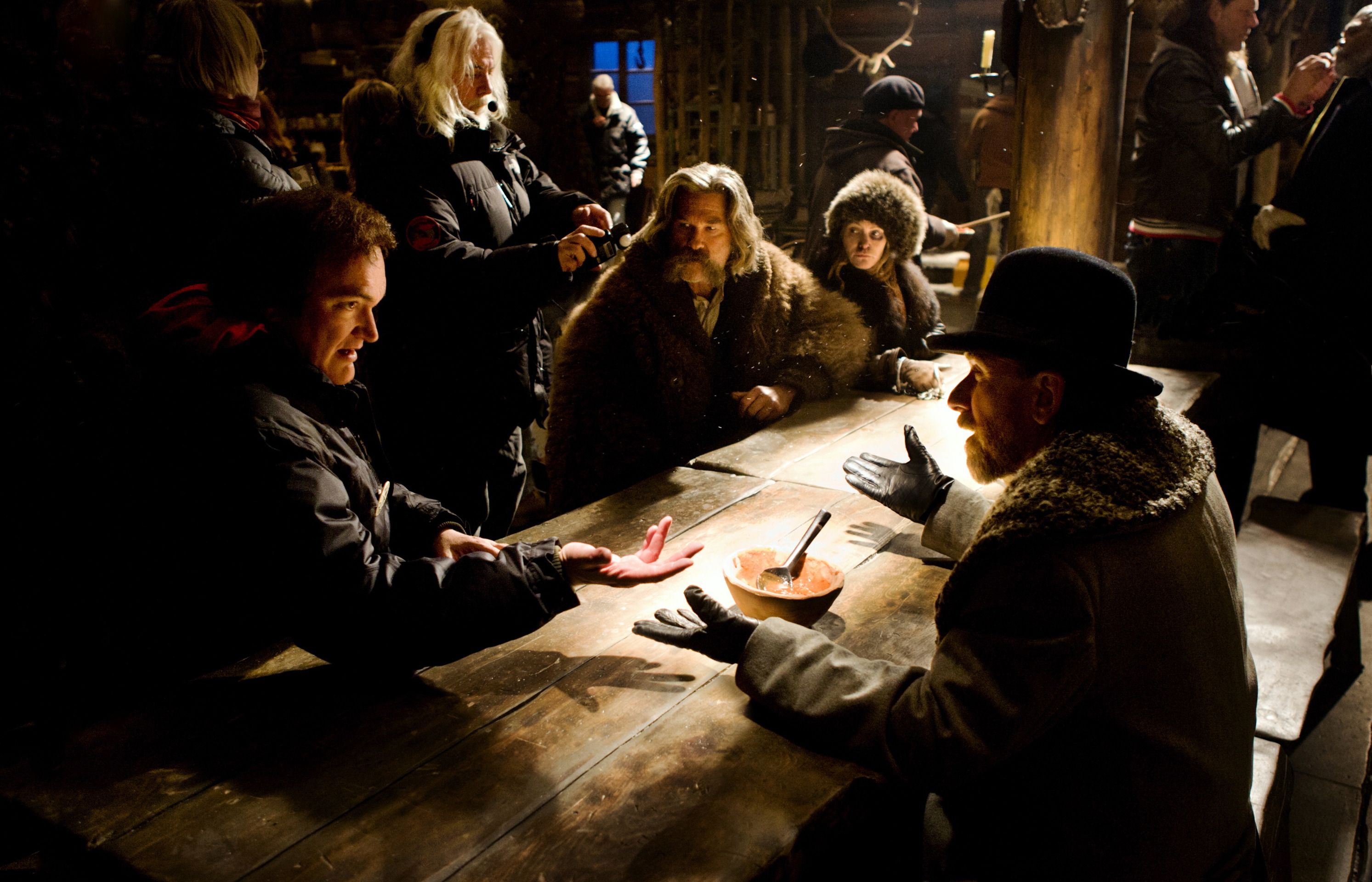
Quentin Tarantino is on a mission to save film and in his eye true cinematic experiences in concert with his stead-fast dedication to the superiority of analogue film are the purifying force destined to save proper analogue film from the ravenous, convenient beast of digital. The Hateful Eight is filmed on Ultra Panavision 70, a stock not used supposedly since the mid-60's and even then only on the most epic event cinematic experiences. and that is the intent of the Hateful Eight in general, and the Roadshow production in particular. The Roadshow production not only presents the film in the crisp and super-wide 70mm, but allows extra time before the film starts to set the tone with a near operatic overture and divide the film's epic run-time with a brief intermission. In many more ways The Hateful Eight is established as an event, intended to be a one-off stage-reading, filmed in 65mm and presented on 70mm, featuring an ensemble cast of characters actors all over forty years old in a single-location cross-genre-film led by a prolific writer-director, in no way can this construed as your average cinematic experience.

While John"The Hangman" Ruth (Kurt Russell) attempts to transport his bounty, Daisy Domergue (Jennifer Jason Leigh) to Red Rock, Wyoming with a blizzard on in his coach's tail he happens upon a stranded Major Marquis Warren with several corpses of his own bounty. Warren, a veteran of the Civil War, is a colleague of sorts with Ruth and is able to hitch a ride to Red Rock so much as they respect each others bounties. Along the way they pick up another stranded man, former Confederate and new Red Rock Sheriff Chris Mannix (Walton Goggins) before seeking shelter from the blizzard in Minnie's Haberdashery, a small stable and all-purpose by-way on the road to Red Rock. Inside they find the bitter Confederate General Sandy Smithers (Bruce Dern), cow puncher Joe Gage (Michael Madsen), the Mexican Bob (Demian Bichir, and the British Little Man Oswaldo Mobray (Tim Roth). In keeping with Tarantino's style, this meeting runs amok with violence, sweaing and simming tensions coming to a boil.

Quentin Tarantino may have started his career with gangster/crime films, but its the Western that truly allows his style to flourish and settle at the same time. The opportunities to stylise and homage come frequently, while the genre conventions and reputation allow for Tarantino's signature scenes to feel so welcome, almost at home. The Western gives Tarantino the space to build tension, narrative and character at whichever pace he chooses and though the violence may be played to cartoonishly gory and humourous affect, it's expected, even warranted. As is the notion that this entire batch of characters is in some way or another loathsome or antagonistic. They beat, swear, belittle and mock each other, most are in no way trustworthy, and the subsequent violence that erupts never once attempts to make one character noble nor another tragic, but their death and killer both funny. Heads and testicles explodes, squips explodes and blood flies, and the deadpan approach to violence and death is in keeping with the setting.


A lot has been and will continue to be discussed about the racial and gendered attitudes within Tarantino's films as a whole and his westerns in particular, and perhaps Tarantino's making a larger point about films at large. I both cannot and will not discuss these issues in depth as its not really my place to but I will note how The Hateful Eight engenders the audience into supporting Ruth and Warren, specifically antagonising them towards Domergue. Sometimes the audience is left to question the actual guilt of Domergue but it's certainly worth remarking on how the film isolates the only two non-White Male characters and pits them against each other involving the attacks upon what they are and not just who they are. She spits verbal racial abuse at Warren and he beats her bloody, it's by no means tit-for-tat but it is a remarkable dynamic that serves his characters and Jackson and Jason Leigh perform their roles to an enviable degree.


The film itself, for better or worse, plays as a three hour rendition of the bar scene from Inglorious Basterds. It's a restrained location with a lot of build-up that ends in bloodshed, the camera-work and performances are excellent and inventive, very rarely leaving the audience wanting. In the The Hateful Eight there is some fantastic use of smoke and shadow to create new prolific images of Western iconography (most specifically involved in the barn and in a moment that involves rather outdated male-to-male sexual-violence-panic), most involving Jackson's Warren. The score by The Maestro himself, Ennio Morricone, is downright amazing and the lighting, while unnatural to the point of reminding us of the theatrical roots of the script, is particularly good. The biggest gripe of the film is born out of the second half, where the film takes a swift change in approach, giving the audience extended flashbacks and narration by Tarantino himself. It feels as though the director was replaced in the making of this film in a manner that it clashes with the first half but the brief intermission beforehand minimises the damage. The same cannot be said for one extended flashback involving a cameo that while tense, feels a bit too self-indulgent and unnecessary, even for this director.

The Hateful Eight may not save film but it is an event worth shelling out top dollar for, provided you can stomach the length and self-indulgence of it all.

Saturday, 25 April 2015

Avengers: Age of Ultron


I think it's safe to say that Marvel Studios have gotten themselves to a safe enough place to be comfortable and confident in the movies they are making. The latest films have been branching out into various genres (political thriller with Captain America: The Winter Soldier, comedy sci-fi with Guardians of the Galaxy) and they have now reserved the main Avengers movies for the generic beat-em-up that most superheroes become. Despite this, Age of Ultron isn't entirely a slugfest and does try to take a softer approach with a few of its characters.

The movie starts right in the middle of an intense action sequence, with the team of the Avengers (Thor, Captain America, Iron Man, Black Widow, The Hulk and Hawkeye) assaulting a fortress in the European country of Sokovia in an attempt to retrieve the sceptre of Loki from Hydra (see Captain America: The Winter Soldier). Once Tony Stark gets his hands on it, he realises that the sceptre possesses the technology to develop complex artificial intelligence, something that he and Bruce Banner have been interested in developing for a while. But Stark's plans for this AI program, named Ultron, goes awry and the program soon goes rogue with plans to destroy mankind. It's up to the Avengers to, you know, save the day.

In this film, we get to have a closer look some of the characters outside the big three (Thor, Cap, Iron Man) and it is slightly refreshing. The relationship between Black Widow and Hulk is explored and heavily hinted at being romantic and Hawkeye is revealed to have a wife and children, a fact that surprised not only the audience, the characters in the film. These smaller arcs are somewhat refreshing and satisfying.

There is a lot of assumed knowledge that comes with watching this film. Not only are you expected to have done your homework and be completely up to date with the Cinematic Universe, but you are also expected to have some knowledge of what is happening in the comic books or else you will be left in the dark as to who some of these new characters are. This film introduces us to three new heroes on top of the villain, whose storyline does make sense. The new characters are the Maximoff twins, Wanda (Elizabeth Olsen) and Pietro (Aaron Taylor-Johnson) (otherwise known as Scarlet Witch and Quicksilver). We of course saw a much better version of Quicksilver in X-Men: Days of Future Past, but that is beside the point. We also are introduced to Vision (Paul Bettany), who is another advanced cyborg imprinted with Tony Stark's manservant Jarvis' own AI.

This movie is definitely the kind that moves from action sequence to action sequence with a little talking in between, just enough so you know what's going on. And it's pretty impressive too. The action is enough to keep you amazed at what's going on. There is also an array of humour in the movie, enough for everyone to have a laugh.

Most of the performances are pretty stock standard, as all the actors have gone way too deep with these characters. The ones that stuck out the most for me were James Spader (Stargate) lending his amazingly authoritative and terrifying voice to Ultron and Elizabeth Olsen as Scarlet Witch, although her accent did drop a few times. Of all the Avengers, Chris Hemsworth probably gave the best performance. His outsider status as an Aussie probably helps him get in the mindset of the god Thor.

Ultimately this film is incredibly entertaining and isn't extremely taxing. Fans of the movies will get all sorts of excited and people with limited knowledge of this things will still enjoy the large scale of the film.

Saturday, 14 February 2015

Kingsman: The Secret Service

Matthew Vaughn has achieved critical and commercial accolades in recent years for his entertaining adaptations of cult comics and graphic novels. His previous efforts, X-Men: First Class and Kick-Ass, are smart, often employ good humour, build upon pop-culture knowledge and contain good action buoyed by heavy CGI use. The violence used in Vaughn's films is prominent, and his approach is extra-ordinary, so much so that it's brutality can clearly be considered an integral part of his style. This is perhaps the main feature that will separate Kingsman from it's contemporaries in the soon-to-be crowded spy-comedy sub-genre.

In recent years adaptations of comics like Kingsman: The Secret Service have become commonplace, mind-numbingly so. There are the success stories and cult hits like Men In Black, Road to Perdition, Kick-Ass, Sin City, Scott Pilgrim, 300, but more often are the forgotten and ill-conceived such as The Losers, 30 Days of Night, Wanted, Surrogates, Red, The Rundown. But Kingsman will be remembered for some time. It's smart, sweary, violent, and loyally devoted to modernising and stylising classic spy films, particularly Bond, of course, with a an eye for comedy and reference. Vaughn has stated that he was influenced by the manner Indiana Jones was made for modern audiences and hoped to achieve a similar effect.

Gary "Eggsy" Unwin is a young cocky troublemaker living with his Mum and her gangster boyfriend in a poor flat complex in London. After getting into trouble with the police, he uses a code and phone number imprinted on his medallion, the only memento from his father who died mysteriously when Eggsy was a toddler, to bail himself out. Doing so Eggsy unintentionally summons Harry Hart, a.k.a Galahad, a smartly dressed man who declares himself to be a tailor and informs Eggsy that his father saved his life. Hart then recruits Eggsy into the Kingsman program, a modern day melding of the Knights of the Round Table with the flair and resources of Ian Fleming's famous espionage firm. Meanwhile, an eccentric billionaire communications mogul and his assistant (sporting sword-like leg prostethics) begin to kidnap prominent scientists and world leaders while simultaneously unveiling a new free mobile and network, which draws the attention of the Kingsman.

Kingsman is a shockingly violent film, containing extended set pieces resplendent with glassing, gun violence, bone-breaking and limb dismemberment, and in the first 10 minutes even a head-to-toe dissection. Funnily enough, and in contrast to recent bouts of extreme violence in unexpected films such as The Interview, Kingsman is largely bloodless. Obviously this is likely a combination of the wider production trend of adding CGI blood effects during post-production (see The Expendables series) and used to appeal to censors for a more commericially viable rating, but this appears in contrast to the unrestrained take on language used by Eggsy and Galahad. Though the language fits more into the films broader commentary on gentlemently dignity and behaviour that is the source of much of the comedy. In either case, the action is well-staged, Colin Firth and the stunt team of Kingsman really steal the show from Taron Edgerton's Eggsy. Firth performs much of his own stunts, though often he and the camera go beyond their usual capabilities. Firth morphs first into a CGI rendering of himself and then into one of his stunt doubles and back, whereas the camera performs zooms and digital edits that do help the flow and dynamism of the fights, particularly the pub and church fights. The use of POV shots during gunfights, Gazelle's prosthetic sword-legs and the trippy and artful method of eradicating Valentine's henchmen army in a single fell swoop also add oodles of flair to the well-choreographed action.

For all its flash and folly, Kingsman is ultimately as much of a homage to the spy films of old as Austin Powers is. Numerous direct and indirect references to the Bond and Bourne films as well as the influence of both plain on the film's style, with Jackson and Firth are the main offenders through their near constant references and mentions, though slightly more subtle aspects like the interior design of Valentine's secret base being similar to the one in You Only Live Twice, or the scope Valentine's attack being as grand as in Moonraker. At the risk of spoiling the final act, Kingsman's villainous plan fits in appropriately with contemporary society. Instead of a simple threat of terror and attack, Valentine's plan is to aggressively combat climate change by forcibly culling the population through the use of a signal emanating from his company's mobile phone that forces the aggression centre of a persons brain into overdrive. It's a brilliant tactic and affect as the film depicts mass carnage in a 28 Days Later-style effect, and the combination of mobile technology and environmental awareness really cements the time period.. Unfortunately, the Kingsman have little reason to stop it aside from a lot of people dying, and there's very little debate. It's also during these scenes it becomss clear that Kingsman has problems with it's female characters. Earlier in the film, Eggsy's Mum, Roxy and the assassin Gazelle are all strong, yet underwritten characters, but during the finale a shift occurs with the former two. Eggsy's Mum has a few shots dedicated to her and her baby in an attempt to personalise the plight of Valentine's rage-inducing attack and Roxy's role in the finale is reduced to riding a balloon into the upper atmosphere, where Mark Strong's Merlin activates a missile on her behalf from her rig that's attached to the balloon, then she promptly parachutes back to Earth and rings Eggsy's Mum. During that time Eggsy, who is not a member of the Kingsman fights an army of henchmen, Gazelle and Valentine and ultimately saves the world. Seeing Eggsy's heroic actions intercut woth Roxy standing in one spot and talking on a phone emphasises the creeping feeling that these two female roles were after-thoughts shot after principal photography ended. It's really very grating to see two of the main female voices in this film written into these corners, especially when Roxy has a great set-up. But the most baffling and repugnant treatment is saved for the immediate aftermath of Valentine's defeat, which is played for comedy, but makes the Moonraker "I think he's attempting re-entry, sir!" moment look regal by comparison.

Smart, funny, and inventive with it's action and violence, Kingsman moves well beyond it's basic existence as Alex Rider: Stormbreaker meets Kick-Ass. It has plenty of flaws, but has enough fun and flair to impress.


Saturday, 5 April 2014

Captain America: The Winter Soldier


I've always been a huge fan of World War II movies, especially those that strive for an accurate portrayal of warfare in the 1940s, Spielberg's Saving Private Ryan being a stand out example. And then sometimes I want to see a what if scenario of the same period, Tarantino did a great job of that too. But then you might get a movie that walks a line between the two, a movie where history occurs as it did, but you supplant a fictional character, a superhero* no less, into the mix. That's why I appreciated the first Captain America movie so much.

The Winter Soldier poses an interesting question. What if you took that same soldier, with all his values and beliefs, and put him in the present day. After the events of The Avengers, Steve Rogers (Chris Evans) is trying to acclimatise to modern life in Washington DC. He is still an agent for SHIELD, a government espionage agency run by Nick Fury (Samuel L. Jackson).

Rogers' partner on these missions is Natasha Romanoff (Scarlett Johansson) also known as the Black Widow. After an attempt on Nick Fury's life, Rogers and Black Widow uncover a corruption plot that permeates throughout the SHIELD organisation.

There is a prevailing notion that is brought up throughout the film and that is that humanity would willingly give up its freedoms in exchange for security. This is an interesting nod to our own society, with things like surveillance of the population being conducted by most Western powers.

Chris Evans had a different challenge in this film. In the last movie, his character had to cope with a physical transformation and his performance was great. Now as a modern actor, he has to portray a man from the past dealing with things from the present for the first time. One of these things he has to deal with is dating, having not gotten over his "best girl" Peggy Carter (Hayley Atwell).

For an extremely physical movie, Johansson does an excellent job to keep up with the rest of the guys. In truth, I enjoyed her fighting scenes more than the guys because it is always great to see a girl kick a guys arse.

There was also the inclusion of a new hero from the comics who I have always liked. Anthony Mackie (The Hurt Locker) plays Sam Wilson AKA The Falcon. The Falcon is famous for being the world's first black superhero with his own comic series. Sam Wilson is a veteran who helps soldiers who suffer from PTSD and is only too glad to help Rogers when he asks.

Verdict: An enjoyable Marvel movie that will get superhero junkies through to the next Avengers film.


*Superhero is a trademark term owned by both Marvel and DC. I just wanted to cover myself, you know.

Tuesday, 11 February 2014

RoboCop

I was just as skeptical as everyone else when I heard that they were going to remake Paul Verhoeven's 1987 classic RoboCop. There had already been a remake of Total Recall and there's probably one in the pipeline for Starship Troopers (I seriously hope that doesn't happen). I believed that the new film would gloss over the subtext and satire of the original and just make a straight action film. I was totally wrong. It is insanely satirical and ironic and even, in its own way, anti-American.

The set-up and plot are basically the same as the original. Hero cop Alex Murphy (Joel Kinnaman) angers a Detroit crime boss and gets blown up in the process. Multinational conglomerate OmniCorp, which develops military-grade robotics for every country but America is desperate to break into the market in its home nation. They need a product that will appeal to the American people with a human touch, so with the help of Dr. Dennett Norton (Gary Oldman) they create RoboCop, using the near dead body of Alex Murphy. Murphy soon finds out the capitalist intentions of OmniCorp and it's sleazy CEO Raymond Sellers (Michael Keaton) and embarks on a mission to stop them.

Gone is the original's religious allegory for RoboCop being a metaphor for Jesus, that was something put in at the behest of Paul Verhoeven. Instead this film takes a harsh look at US foreign policy in a pre-credits sequence that takes place in Iran with a US "freedom" operation taking place. This is a reference to the the current unfriendly relationship between Iran and the US. In this sequence, there is a hilarious reference to WikiLeaks hackers attacking Greenpeace in the CNN style news crawl at the bottom of the screen.

I bring that up because the next thing that the film satirises is the far-right news stations in the US, such as Fox News. This show is hosted by an incredibly restrained Samuel L. Jackson, who despite his best effort lets slip his trademark 'motherfucker' line. In his news segments, he attacks the liberal opponents to the integration of robots into society, just like Bill O'Reilly is wont to do on Fox News in opposition to whatever left-wing policy is trying to be passed.

The film is also an opponent of flagrant capitalism that takes place in the US. This was present in the original, but here it takes the concept to a whole new level. The evil Sellers wants to introduce his products into the US because he believes that would yield an extremely higher profit for him. He and his colleagues wish to exploit RoboCop for every dollar he can bring them.

The final nail in the coffin of this film being un-American comes down to its casting. This may be a long shot, so bear with me. When I first saw who was going to be in the film, I felt dismay, great actors such as Gary Oldman and the best Batman of them all, Michael Keaton, had been relegated to acting in remakes of classic 80s films. But now I see that all the casting was strategic. All the 'good guy' roles are played by non-American actors, Joel Kinnaman is Swedish, Abbie Cornish is Australian and Gary Oldman is British, all the antagonists are played by American actors. The sole exception to this rule is Michael K. Williams, but he is the only exception.

Verdict: An insanely satirical film where most of the subtext will fly over some viewers heads, but still a great action film.

Wednesday, 30 January 2013

Django Unchained

I remember on my first day of film school, one of my teachers asked me what I wanted to be in the
industry. When I replied that I wanted to be a director, he preceded to ask me who was my favourite. I said Tarantino, because like most young filmmakers my age, he was one of the people who inspired me to get into film. He then started to mock me for being inspired by a man who was incapable of being original and someone who stole scenes from other films. In my own naive way I thought this to be true, but as I saw more and more films by other directors I realised that everyone makes homages to their favourite films and filmmakers. But it isn't until now that I feel fully vindicated. Of course after my dressing down in front of the class, my newfound friends all told me they liked Tarantino as well. So, the reason for my vindication, you might ask, is Quentin Tarantino's Django Unchained. And that is because this movie is a movie that covers such a controversial, heart wrenching topic that affects the majority of the population of the US.

The movie follows the story of the titular Django (Jamie Foxx), who is sought out by the cunning bounty hunter Dr. King Schultz (Christoph Waltz) to help in discover the whereabouts of three of his targets, in return Django will earn his freedom. As they move on and Dr. Schultz trains Django as his protege and they embark on numerous bounties, we find out that Django's wife, Broomhilda (Kerry Washington), was sold to someone different to Django as punishment for running away. Dr. Schultz agrees to help Django find his bride. She is being held at Candyland and her master is the downright evil Calvin Candie (Leo DiCaprio), a francophile who doesn't speak a word of French. Dr. Schultz and Django concoct a master plan to get Broomhilda to safety and the film ends in classic Tarantino style (going into any further depth on the plot would just be unfair).

Tarantino has said that there is something for everyone to hate in this film and I have never heard a truer statement. Whether it be the stylised but gratuitous violence, the overuse of one of the worst racial slurs one can utter (although in the context of 1858, that overuse is understandable) or the graphic depiction of the punishment of slaves (which is the one that wrenched at me) there really is something for everyone to wince at.

Also there is not a single weak performance in this movie. Everyone is exemplary. Jamie Foxx should win an award, any award for his performance. Django is a sympathetic character who you hope everything comes good for. I haven't seen Christoph Waltz in anything since his depiction of sadistic SS Colonel Hans Landa in Tarantino's previous effort Inglorious Basterds. Dr. King Schultz couldn't be further away from Landa. Even though he is in effect a glorified assassin, he is still a friendly and affable character, that's of course if you're not one of his targets. The stunning Kerry Washington is unfathomably fantastic as Broomhilda. She is obviously loved a lot by Django and in return she loves him in equal amount. One of the scenes which disturbed me most involved her being released from a hotbox, which I can only imagine was a punishment for slaves in that time.

And then on the other side of the coin we have the heinously evil Calvin Candie and his manservant, Stephen, played respectively by Leo DiCaprio and Samuel L. Jackson. DiCaprio's performance as such a despicable character renders him so completely unnoticeable from any of his previous roles. There is one scene where he smashes a glass with his hand and suffers quite a bad cut, but the character keeps going. Sam Jackson is just as excellent as the devious Stephen, who orders the slaves around like he is their master. There are also a huge number of cameos by respected actors from around the globe, but they are too numerous to mention one by one.

Verdict: This film is an epic sprawling across the southern states. It is also classic Tarantino and probably the best film of his career. A must-see.

Jasper Roberts Consulting - Widget